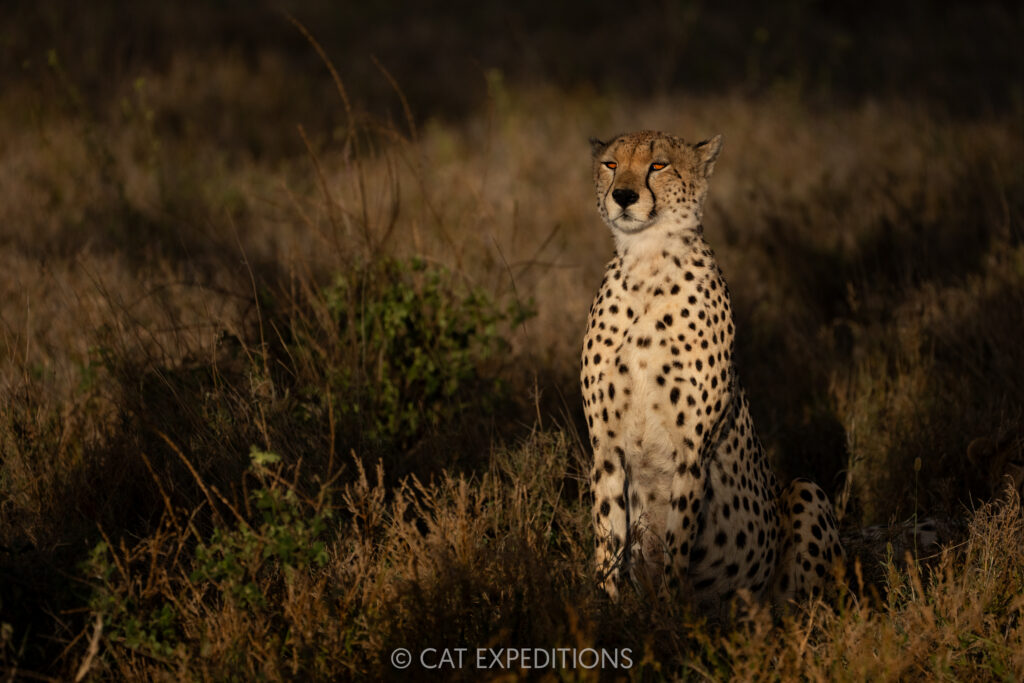
After a years absence, we returned to the Serengeti for our cheetah and serval photo tour. And what a tour it was, maybe the best trip we have ever run. We were so fortunate to see all six species of wild cat in the Serengeti, and more importantly had incredible behaviors we were able to observe. Read the rest of our cheetah and serval photo tour 2025 trip report to get all the details!
Highlights of the 2025 Cheetah and Serval Photo Tour
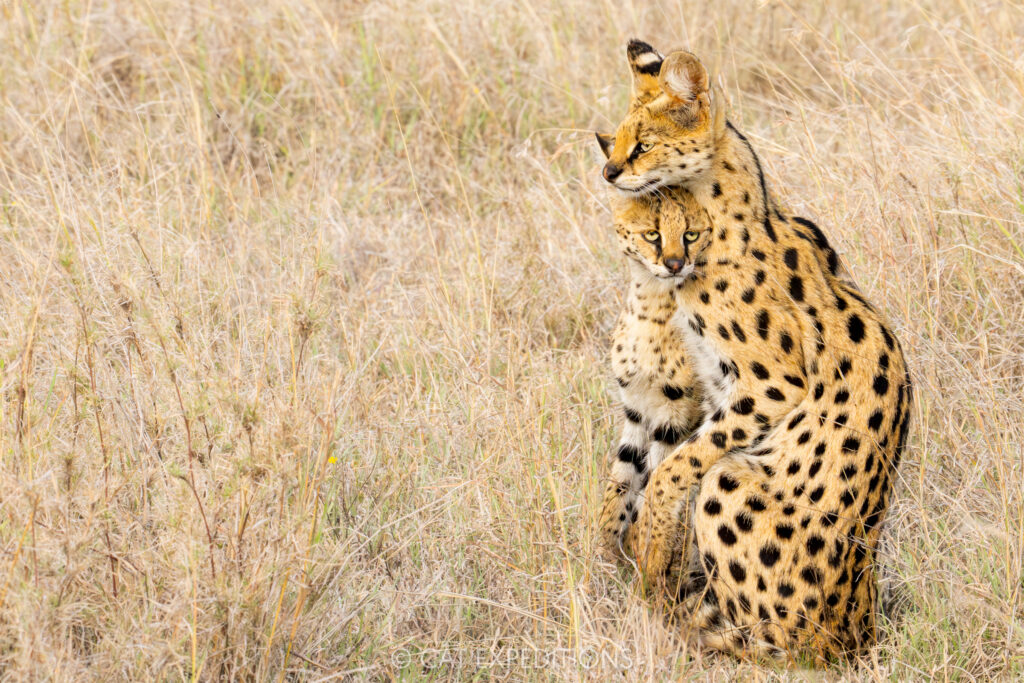
Serval: In total, we photographed six different serval, including a mother and her kitten, who we observed for multiple hours. Sightings averaged forty minutes, at an average distance of twenty meters. For our closest encounter, we had a serval hunting near us at just three meters.
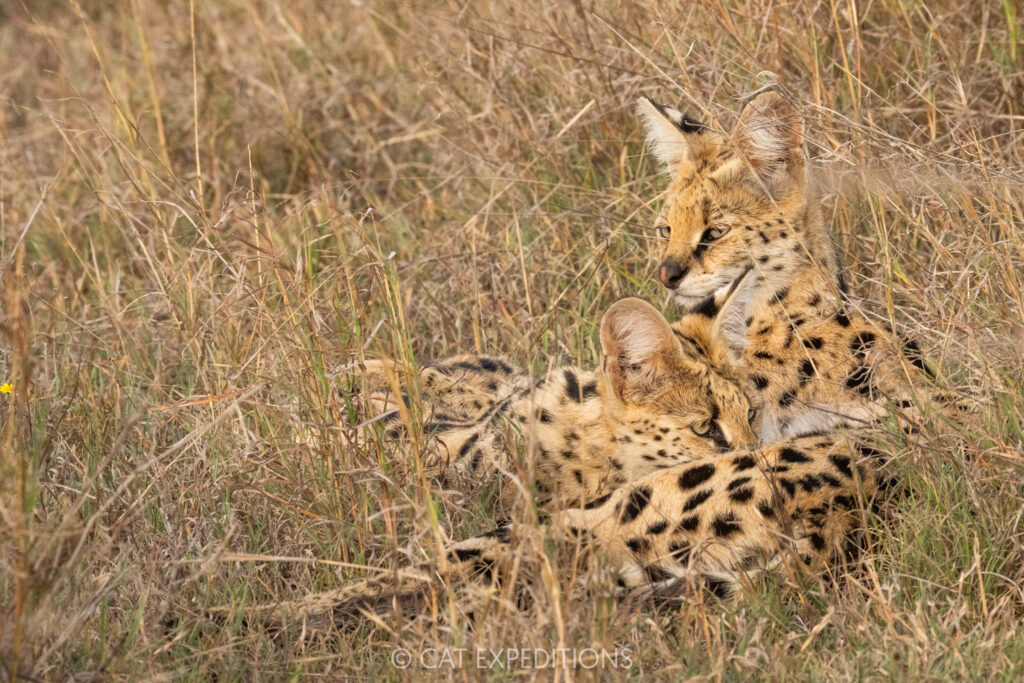
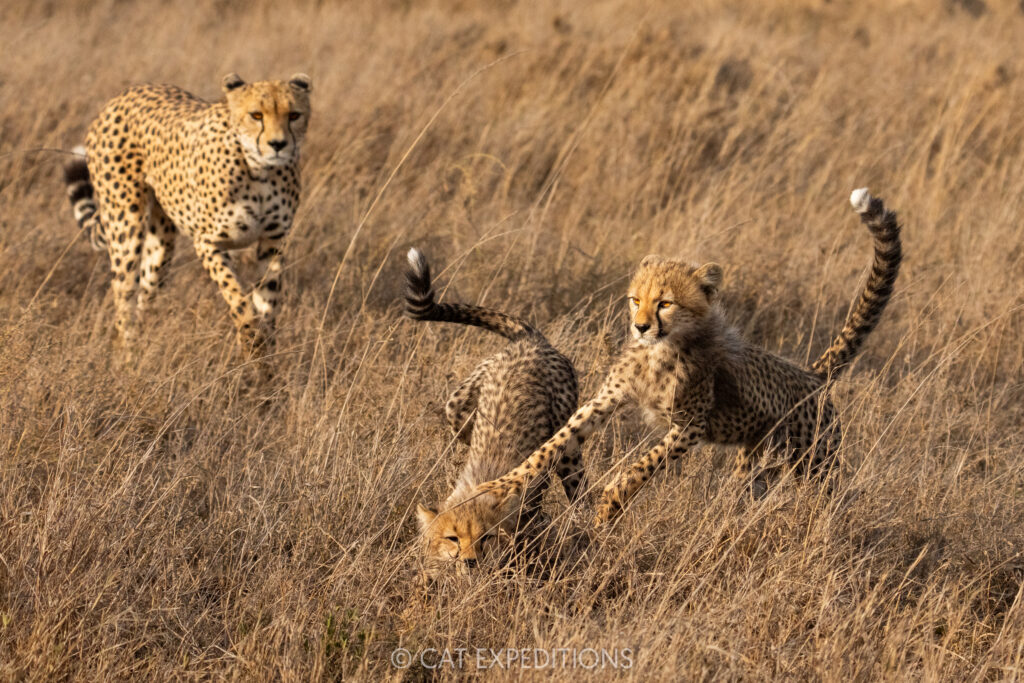
Cheetah: We had five different cheetah sightings, with the highlight being spending about three hours with a mother and her two really cute and playful kittens.
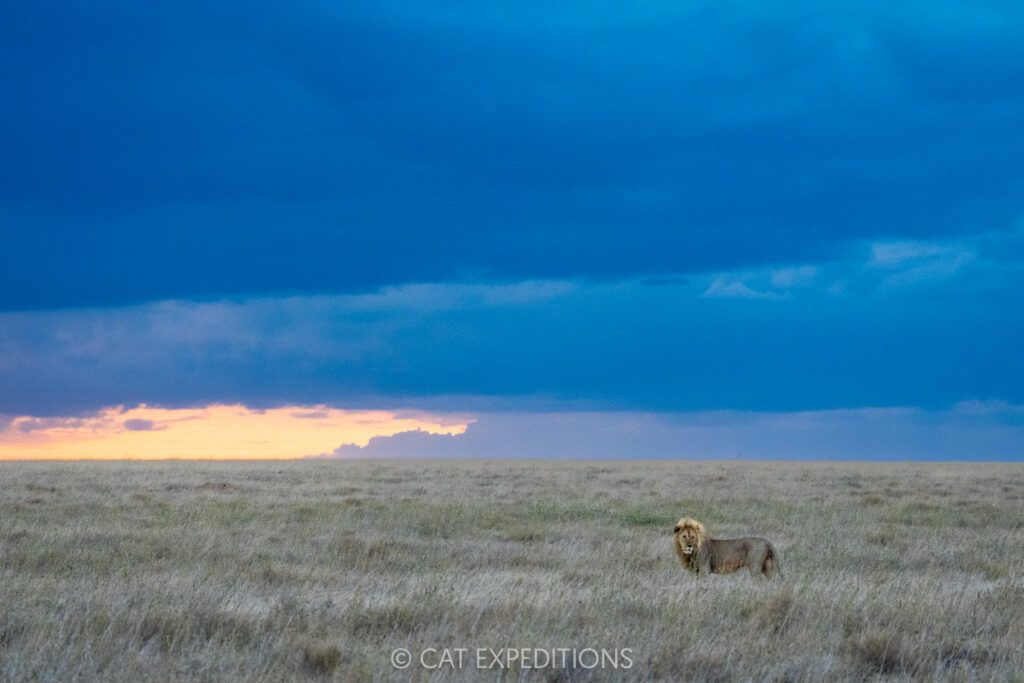
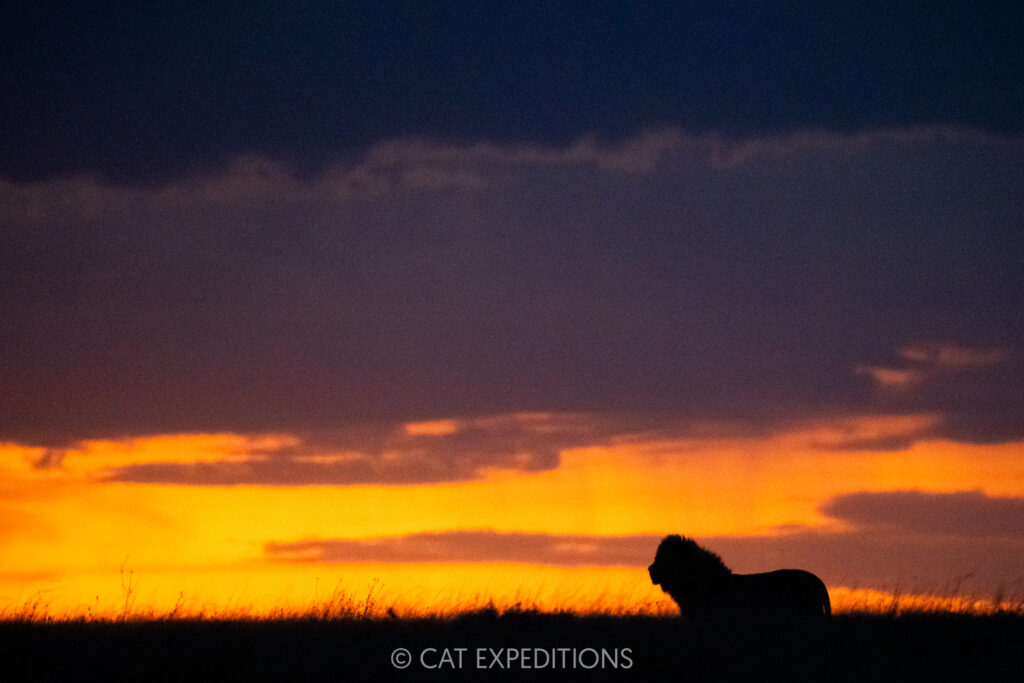
Lions: Though not our target wild cat species, we had nice sightings of a lion pride consuming both and eland and zebra on consecutive days, as well as a nice sunset session with two male lions walking through the savanna.
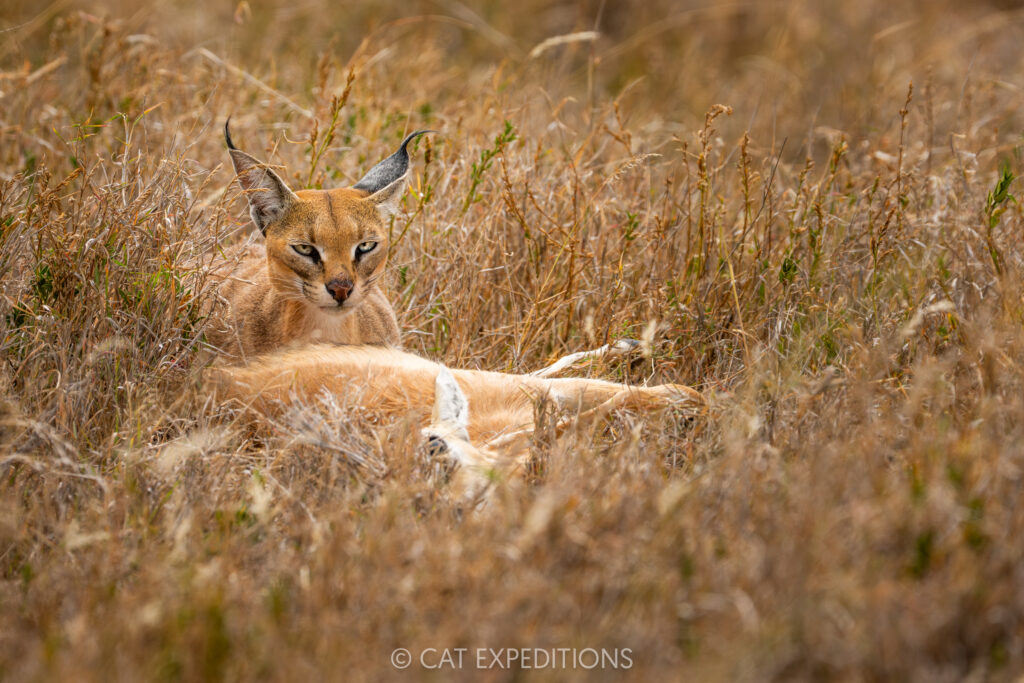
Caracal: We were very fortunate to see most elusive of the wild cats in the Serengeti, observing a female caracal for well over an hour as she sat and fed on a Thomson’s gazelle she had killed.
Detailed Trip Summary 2025
Day 1: All of our guests arrived without delay to Kilimanjaro airport, where they were picked up and brought to our transfer lodging. We met for dinner and presented the details on how the trip would unfold.
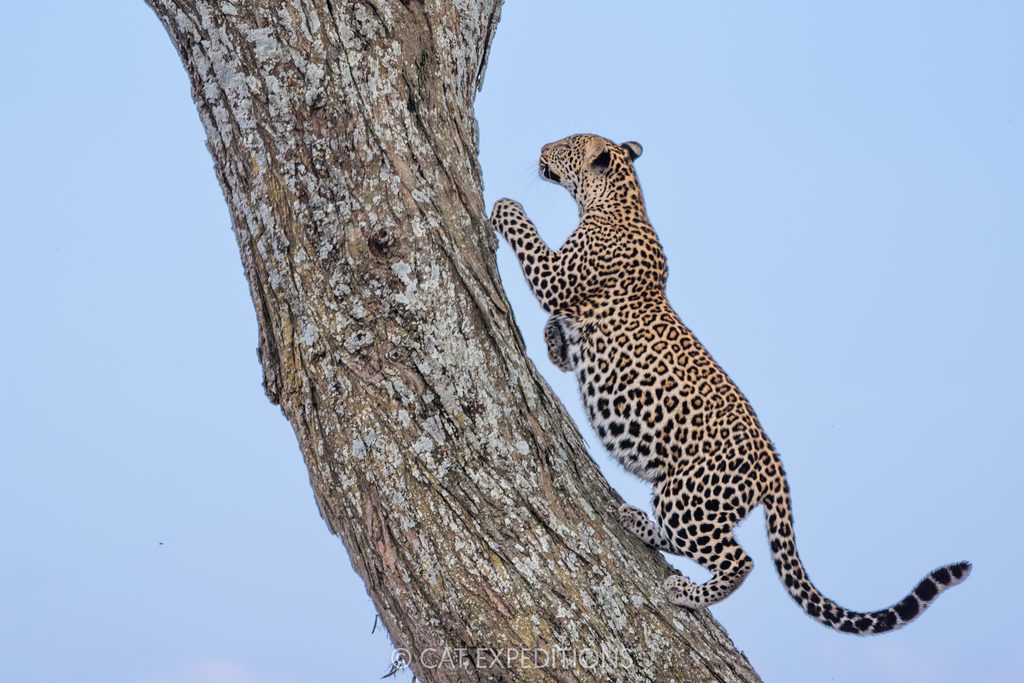
Day 2: After an early breakfast, we made our way to Arusha airport to catch out 1.5 hour flight to Seronera in the central Serengeti. After landing, we met our local guide and started our game drive to Namiri, our camp for the entirety of the trip. We immediately passed hippos wallowing in one of the few pools in the Serengeti. Not long after, we found a male leopard cub resting perfectly in the fork of a tree. As soon as we arrived, he stood up, climbed higher into the canopy, and eventually found another comfortable perch near the top. Fortunately, his new position gave us an even better angle, and we were able to spend some wonderful time photographing him.
Out on the plains, two secretarybirds stalked through the grass while Thomson’s and Grant’s gazelles, Plains zebra, and Coke’s Hartebeest fed on the fresh green shoots brought up by the first rains. Two hartebeest were stretched out resting in the grass, while another later stood sentinel on top of a termite mound. Everywhere we looked, the plains seemed to be filled with life.
A large male spotted hyena was wallowing in a muddy section of road, his notched ears and scarred appearance giving away that he had clearly been around for a while. Completely coated in mud, he looked especially impressive. We also spotted a brilliantly colored red-headed agama perched on a rock and a lioness from the Kibumbu pride resting quietly in the shade.
A limping female warthog beside the road provided a more sobering moment, as her injury appeared severe enough to make us wonder how much longer she might survive. Around her, though, signs of renewal were everywhere. Fireball lilies were beginning to emerge after the first rains, and the plains were covered with feeding gazelles and hartebeest. A steppe eagle cruised low overhead, a small family of warthogs trotted through the grass, topi stood ruminating on termite mounds, and wildebeest occasionally broke into a run across the open country.
We also encountered a particularly shy giraffe that seemed determined to keep a bush between itself and us. Every time we moved, it repositioned, until finally its head appeared above the vegetation as it continued feeding. A steenbok added another small antelope to the morning’s list, and as we approached camp, a bull elephant came steadily walking in our direction.
The wildlife barely paused for lunch. A reedbuck dashed past the lodge, while the bull elephant from earlier wandered right up to the tents and temporarily prevented one group from leaving for our afternoon safari.
That afternoon, we began slowly working through promising habitat in search of caracal, carefully scanning as we drove. Although the caracal remained elusive, we had beautiful looks at Fischer’s lovebirds glowing in the late-afternoon light and encountered a pair of steenbok standing in the road. Another enormous bull elephant appeared farther on, this one in musth and carrying an impressive set of tusks as he strode across the landscape.
Then came one of the highlights of the day. We heard about a four-month-old leopard cub high in an acacia tree and made our way over. He was astonishingly high, perched almost at the very top of the tree and looking rather nervous. Below him, draped across the fork of the trunk, hung the remains of a gazelle his mother had killed.
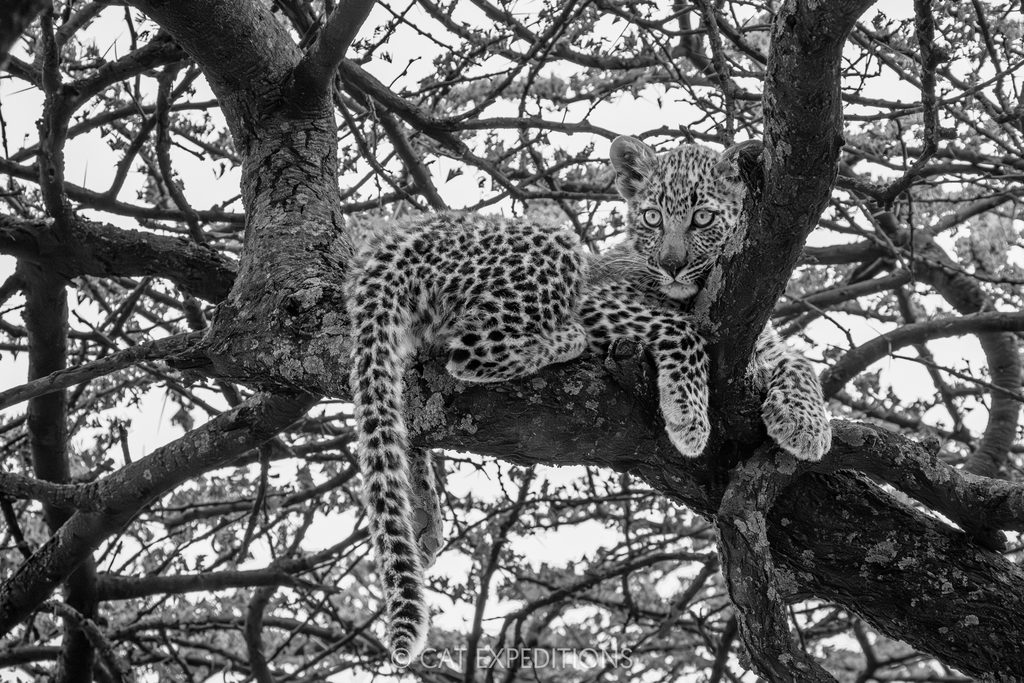
We stayed with the cub as the sun began to drop, and eventually his mother, Kisaru, appeared walking toward the tree. She settled nearby, drifting in and out of sleep while occasionally lifting her head to watch us. At one point she softly vocalized toward her cub above, creating an especially intimate moment between the two. We stayed with them until the last of the light disappeared, then left mother and cub together beneath the darkening sky.
On the drive back to camp, one of the groups added one final sighting to the day: a bat-eared fox moving through the darkness.
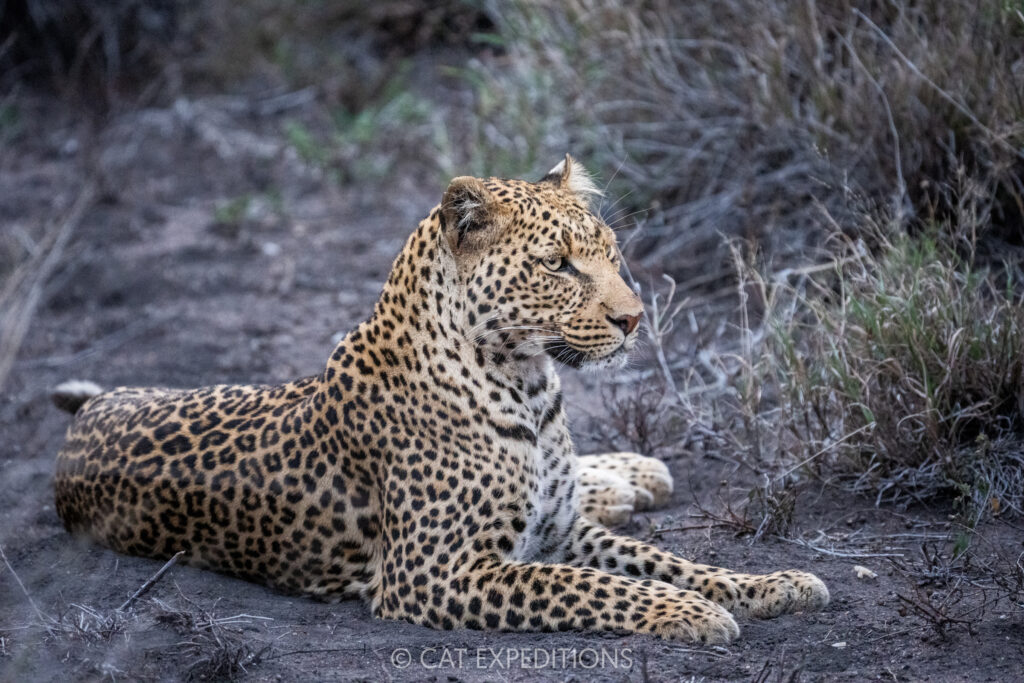
Day 3: The night had been anything but quiet, with leopard, lion, and hyena calls carrying through the darkness around camp. By 5:30 a.m. we were up for coffee, and at 6:00 we headed out beneath a beautiful pink-and-purple sunrise. Almost immediately, we found fresh leopard tracks near camp, possibly from the same animal we had heard calling during the night.
As the sun began to rise over the distant hills, a giraffe fed quietly in the golden light while a hyena moved across the plains far in the distance. Then came the sighting we had been hoping for: a cheetah.
He was already focused on a Grant’s gazelle and began to stalk, gradually closing the distance. For a moment it looked promising, but suddenly the gazelle caught his scent and began to move away. The cheetah abandoned the attempt and continued walking, scanning constantly for another opportunity. Before long, though, a large group of hyenas appeared running in his direction. He immediately turned and moved away at speed, clearly unwilling to risk a confrontation.

We followed him until he eventually settled atop a termite mound, surveying the plains from his elevated perch. After resting there for some time, he headed toward a swamp fringed with long, lush green grass. The contrast between his golden coat and the deep green vegetation was spectacular.
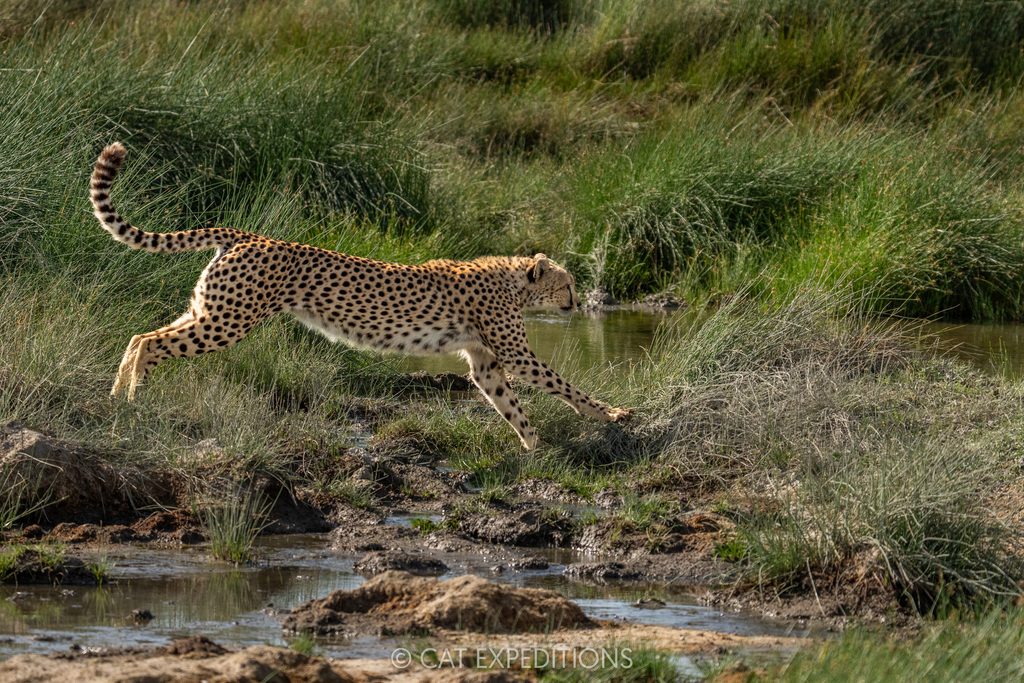
He seemed determined to find a place to drink but was clearly wary of the soft ground, testing one spot after another before finally reaching a small rocky patch where he could safely lower his head to the water. Two Egyptian geese on the opposite side of the wetland loudly announced his presence the entire time. Nearby, the tips of a reedbuck’s horns were just visible above the grass. After drinking, the cheetah made an attempt toward another reedbuck, but the swampy ground made any real chase impossible.
Still hungry, he continued searching. At one point he passed within about ten yards of one of the vehicles, giving us incredible close views.
After stopping for a bush breakfast, we caught up with him again. This time he had found a mixed gathering of hartebeest, including calves, together with Thomson’s and Grant’s gazelles. He watched them intently from a distance for a long time, carefully assessing the herd. When he eventually began to edge closer, the antelope spotted him, and with his cover blown he finally moved on.
For our last stop of the morning, we decided to return to the leopard tree from the previous evening. What we expected to be a quick check turned into another extended sighting. Kisaru, the female leopard, was back in the tree feeding on the gazelle she had dragged up the previous day. We watched as she carefully stripped meat from the skull and legs, the sounds of crunching bone and skin carrying down from the branches. Her cub was nowhere to be seen, but given her relaxed behavior, we suspected he was hidden somewhere nearby.
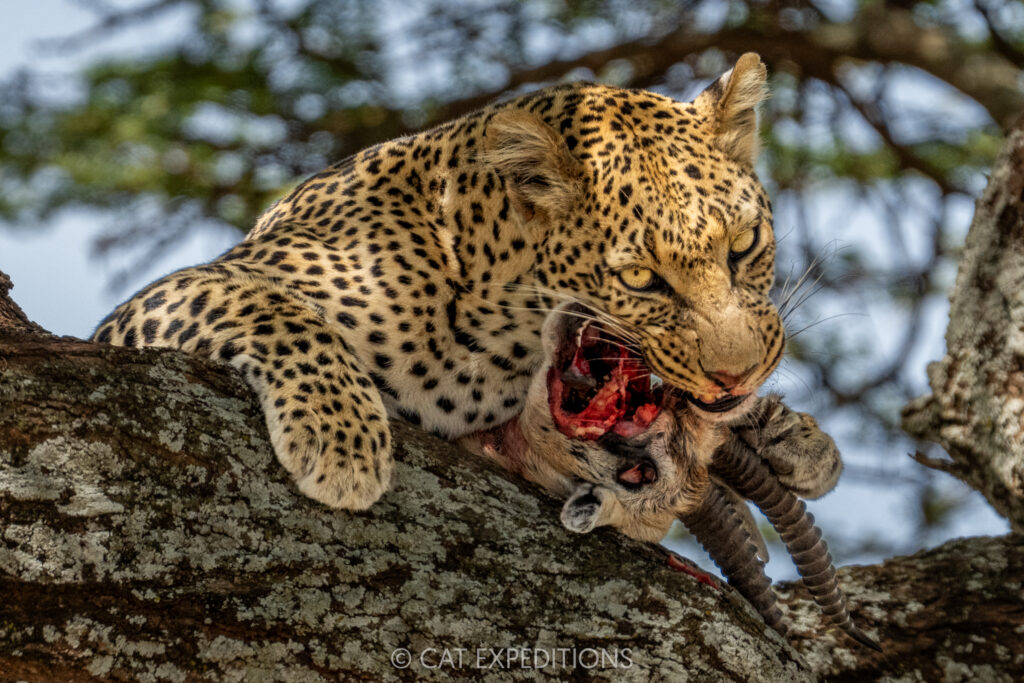
It had been an extraordinary morning: predators calling through the night, a long and beautifully cheetah sighing, and an intimate look at a leopard feeding high above the plains.
After a photography lesson on exposure with Sebastian, we headed back out at 4:00 p.m. Almost immediately, one of the vehicles spotted a serval. Unfortunately, it was an extremely shy individual and slipped straight into a bush before anyone could get photographs. When the second vehicle arrived, the cat was accidentally flushed and bounded away through the grass. We searched briefly, but it was obvious the serval was uncomfortable with our presence, so we decided to leave it alone and continue on.
Not far away, we came across a journey of giraffes beside the road, followed by a troop of olive baboons moving through the tall grass, many of the females carrying tiny babies on their backs. A steenbok fed quietly on the fresh green growth nearby.
The sky became one of the highlights of the afternoon. Several large bull elephants stood out beautifully against a dramatic wall of weather, with purple curtains of rain falling along the horizon beneath a pale cream-colored sky and enormous dark-blue storm clouds building above them. It was an incredible scene and gave us some wonderfully atmospheric photographic opportunities.
We then reached an area that had recently undergone a controlled burn. The first green shoots were already pushing through, and hundreds of ungulates had gathered to take advantage of the fresh growth. Antelope and zebra were scattered across the plains in every direction. We carefully scanned the open country for cats, and we were rewarded with a cheetah sighting at sunset.
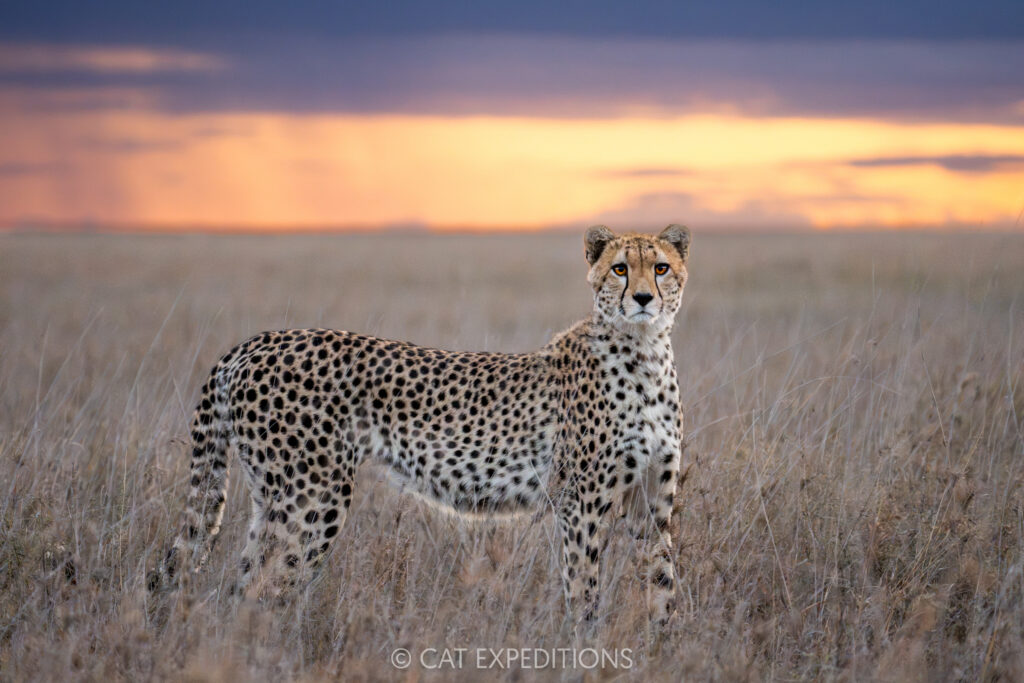
Later in the drive, one of the vehicles developed mechanical trouble, so the afternoon took an unexpected turn as we helped transfer the group while a mechanic made his way out to the stranded vehicle. With everyone safely accounted for, we began the drive back toward camp.
Even after dark, the Serengeti kept producing wildlife. A hyena appeared along the road and walked beside us for a stretch as we made our way home, bringing an eventful afternoon to a close.
Day 4: We left a little earlier than usual, heading out at 5:45 a.m. and making our way toward the yellow fever acacia forest. Almost immediately, we heard baboons alarm calling somewhere in the trees, a good indication that a predator might be nearby. We searched carefully but never managed to locate whatever had caught their attention.
The morning light was spectacular. A dark navy-blue sky hung behind the forest while the rising sun illuminated the yellow fever trees, making their pale trunks seem to glow against the stormy background. Nearby, a small herd of elephants was busy tearing apart acacia branches, while a lone male giraffe fed in beautiful light and allowed us to sit quietly beside him for some wonderful photographic opportunities.
Meanwhile, the other vehicle had found a serval. Our local guide initially spotted what appeared to be a serval kitten, but the little cat was extremely shy and disappeared before they could get close.
While continuing to scan the grasslands for serval, we noticed a pride of lions far off in the distance and drove out to investigate. It was the Zebra Pride: five females, two males, and an incredible ten cubs, a mixture of roughly five- and seven-month-old youngsters. Two of the lionesses stood atop a termite mound as though preparing the group to move, and soon the pride began walking single file through the grass. With the soft morning light catching them as they passed, it was a spectacular scene.
Then the radio came alive with an almost impossible choice. One vehicle had found a caracal with a kitten, while our other vehicle was sitting with a serval. For a trip centered around these elusive smaller cats, it was the kind of problem we were very happy to have. We chose the caracal and began the roughly 25-minute drive, while the other group also left their serval to join us.
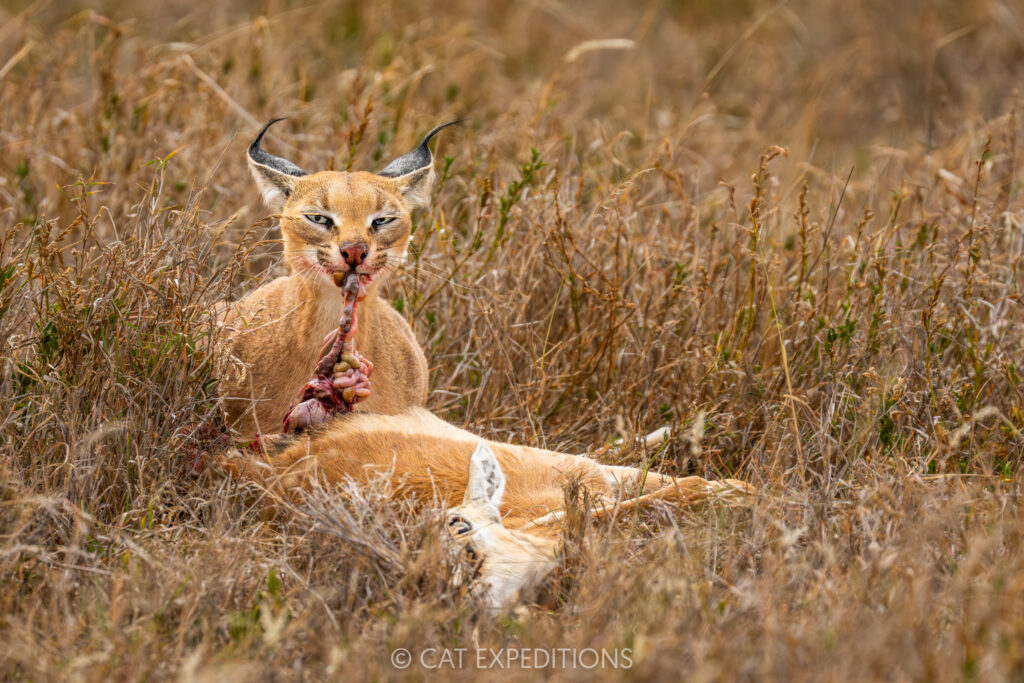
When we arrived, the female caracal was lying beside a freshly killed Thomson’s gazelle—an animal noticeably larger than the cat herself. It was an extraordinary reminder of just how capable these small predators are. Her kitten had already disappeared into a den somewhere nearby, leaving the female alone with her prize.
She stood several times before settling back into the grass, and we were struck by just how small and slender she looked. Even while we knew exactly where she was, her tawny coat allowed her to practically vanish into the vegetation.
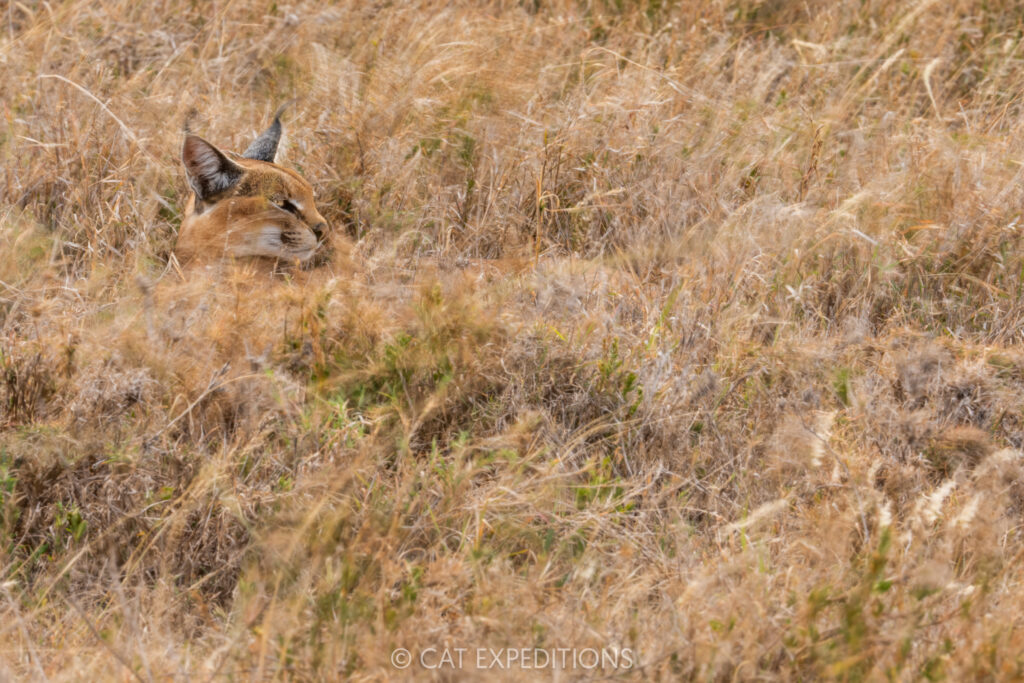
Eventually, she got up and began feeding. Once she had eaten her fill, she started caching the carcass, raking her claws through the surrounding grass and vegetation and pulling material over the gazelle to conceal it. We watched for a while longer before leaving her in peace with the kill—an incredible end to a morning filled with lions, serval, and one of the best caracal encounters we could have hoped for.
Having had such a spectacular morning, we didn’t believe our day could get any better. Boy were we wrong. We were still on the search for a good serval sighting, and after searching for an hour, we found a beautiful female. After watching her for a while, we realized she was not alone, she had a kitten. The kitten was more shy, but we knew if we stayed with mom, eventually the kitten would join her.

She was actively hunting, using her large ears to hear the rustling sounds of rodents visually obscured by the tall grass. Servals are incredible hunters, with keen senses and incredible jumping abilities. It didn’t take many tries until she was successful in catching her rodent prey.
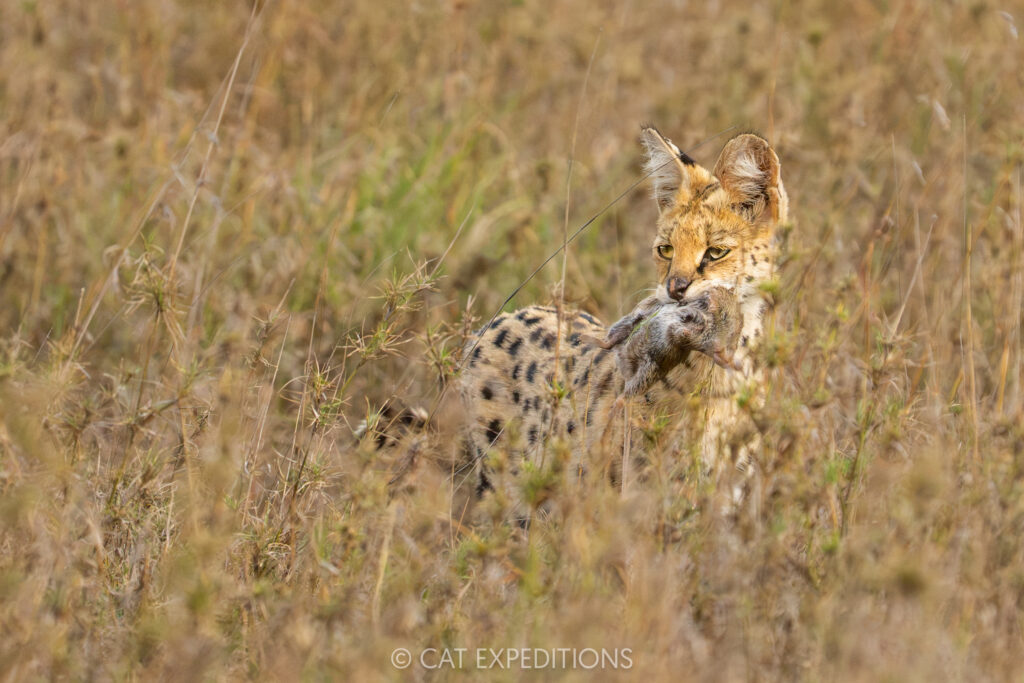
With her prized prey in mouth, we knew the kitten would come quickly to get it from her mom, or so we thought. The kitten did come, but instead of feasting on the rodent immediately, she nuzzled mom and nursed instead. After nursing, she decided she wasn’t full yet, and also consumed the rodent. What an incredible serval sighting!
Day 5: The morning began right around camp, where our local guide found a chameleon clinging to a bush. Not long after, we came across very fresh serval tracks on the road. We searched the surrounding area carefully but never found the cat itself. While scanning the plains, we could see the Zebra Pride moving in the distance, so we decided to make our way toward them.
The other vehicle had its own unusual elephant sighting when they found a large bull lying down. He eventually got back to his feet, but seeing such a massive animal fully reclined out in the open was a rare sight. We also watched a young elephant mock-charge a nearby giraffe, adding a bit of drama to the morning.
We then settled in with the Zebra Pride and spent much of the morning watching the lions in beautiful golden light. The females and cubs were especially playful, and at one point the youngsters discovered an old buffalo skull and began chewing and tugging at the horns. It appeared that two cubs were missing from the group that morning, however, which immediately caught our attention – did they not survive the night?
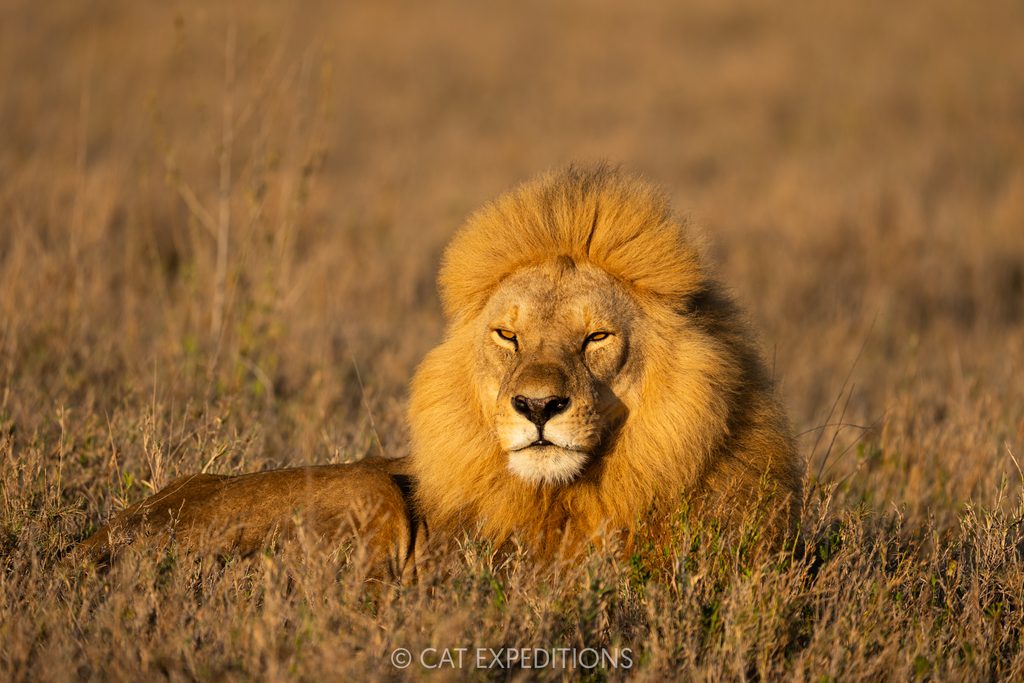
One of the pride males eventually arrived and joined the others. The second male had not been seen for roughly a week following a serious fight with two challenger males, and at that point it was unclear whether he was recovering somewhere out of sight or had succumbed to his injuries.
As the pride began to move, the lions filed through the savanna in a long line and eventually walked straight toward us, giving us some wonderful photographic opportunities. Later, they settled into the shade around a small acacia. Several cubs climbed onto a sloping trunk while others nursed beneath the tree, and eventually, as the light became harsher, we left them to find a place for breakfast.
At our breakfast stop near one of the rocky kopjes, we found the shed skin of a cobra. After eating, we checked on the pride once more and found them still resting in the shade, now with the large male fully settled in among them. On the way back toward camp, we stopped to photograph a pair of ostriches and passed several hartebeest and Grant’s gazelles scattered across the plains.
That afternoon, another guide radioed that they had found a serval, so we headed straight over. We saw the cat almost immediately, but it remained noticeably nervous. We waited to see if it might relax, but when it continued to seem uncomfortable with our presence, we chose not to push the sighting. At almost the same time, another serval was reported much closer to camp.
On the way there, we passed a beautiful journey of giraffes near camp before reaching the second serval. This individual was far more relaxed and actively hunting, so we settled in for what became a two-hour observation. It was the same female that had been seen the previous evening and was known to have a kitten nearby, though we never saw the youngster that day.
For the next two hours, she moved methodically through the savanna scrub, constantly listening and searching for prey. The wind seemed to make hunting difficult, and we watched her make around five separate attempts without success. As the light began to fade, we finally decided it was time to leave. Almost as if on cue, she launched into one last pounce—and this time came up with a rodent.
After two hours of watching her work, seeing that final successful hunt felt like the perfect ending to the afternoon.
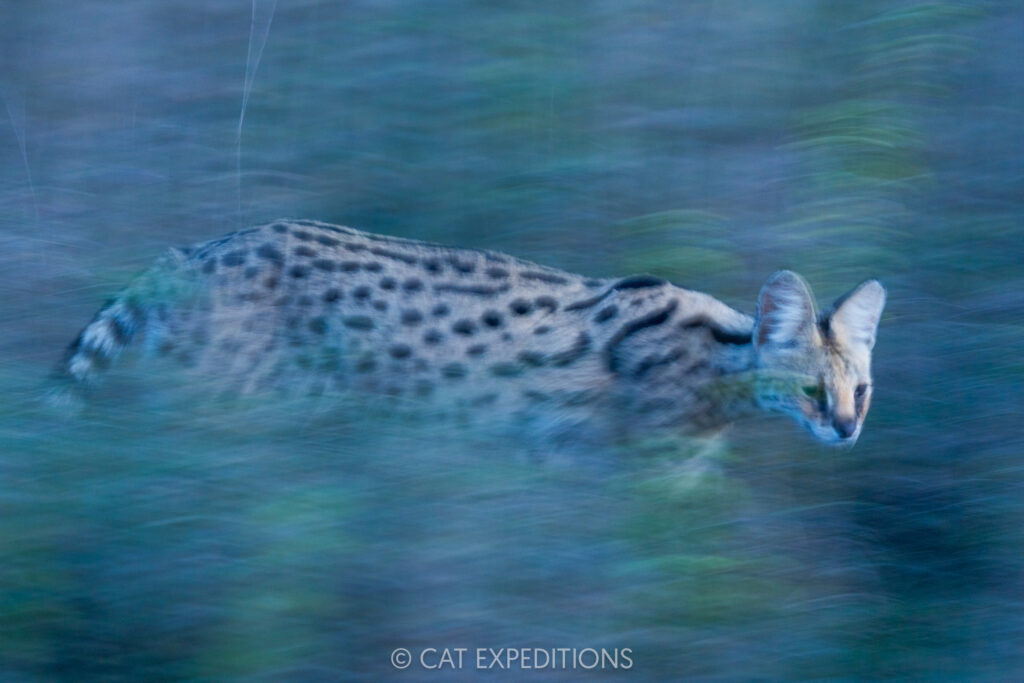
Day 6: The morning started just outside camp with a beautiful martial eagle perched right beside the road. From there, we headed toward a vast open-plains area that was absolutely teeming with wildlife. Thousands of antelope dotted the grasslands, large groups of zebra moved across the plains, and a sizeable clan of hyenas could be seen in the distance. We also watched a large male warthog sharpening his tusks, and photographed a couple of grass owls. The other group picked out an eland far away, while we also encountered three dik-diks moving through the grass and a golden jackal lying completely relaxed in the open.
Then our local guide made an incredible spot. Scanning through binoculars, he picked out a cheetah from a remarkable distance. By the time we reached her, we realized she was a mother with two roughly seven-month-old cubs. A hyena was nearby at first, keeping the family alert and cautious, but once the threat moved away, the mood changed completely.
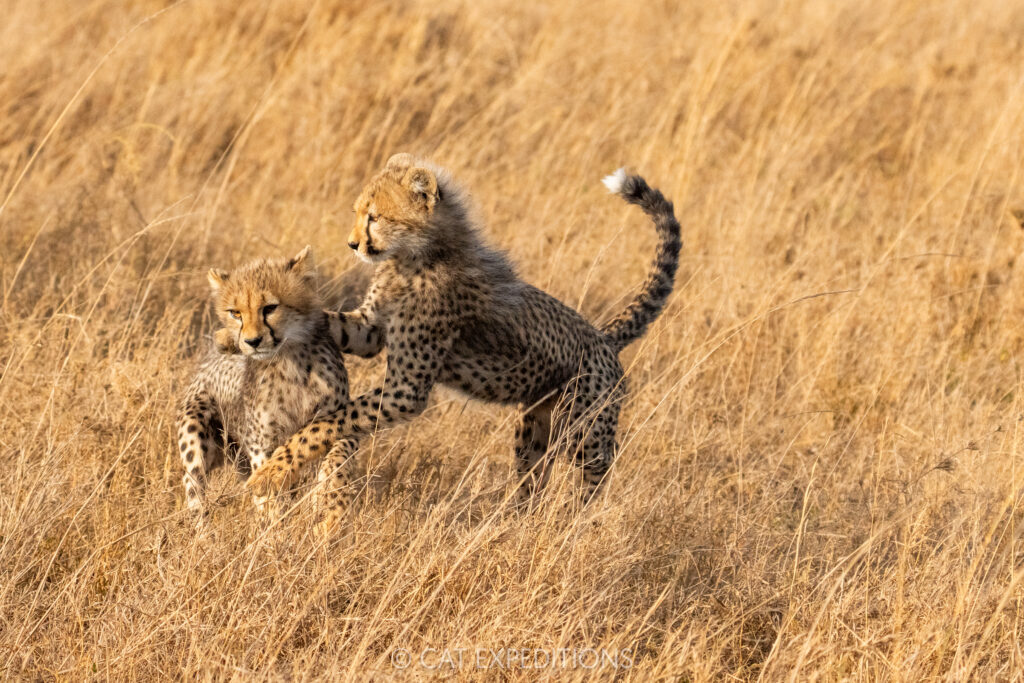
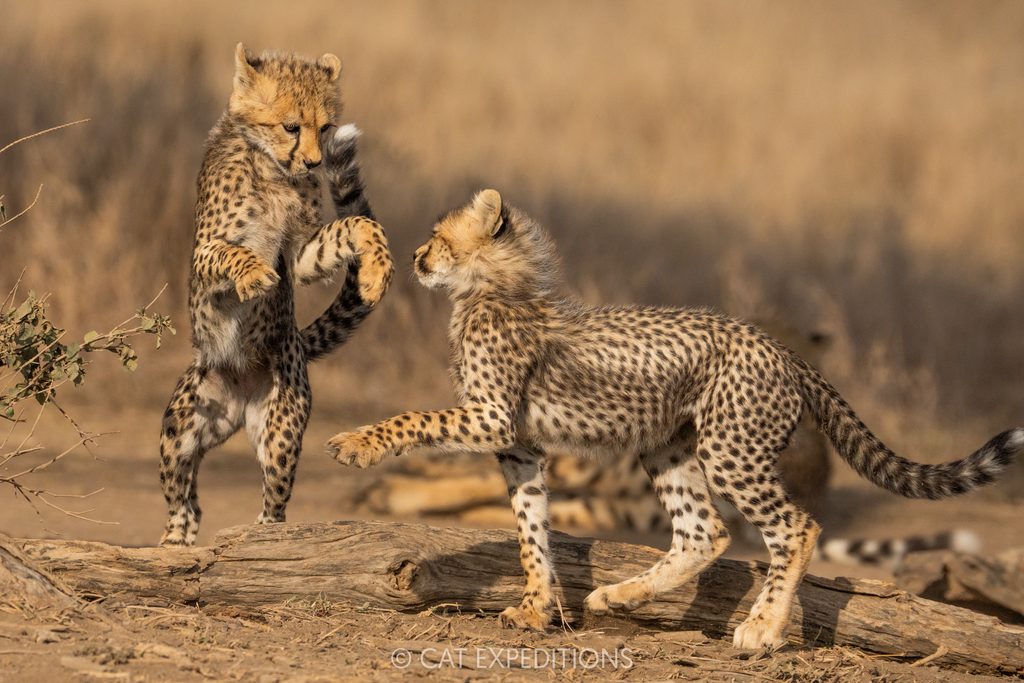
The cubs began playing around a fallen dead tree, scrambling along the trunk, leaping off it, rolling over one another, and bursting into short chases. Their acceleration was astonishing—one second they were lounging, the next they were flying across the ground. Their mother often stood or sat near them, scanning the surrounding grasslands while the cubs explored and experimented with climbing. A few of their less graceful attempts made us a little nervous, but they always managed to sort themselves out.
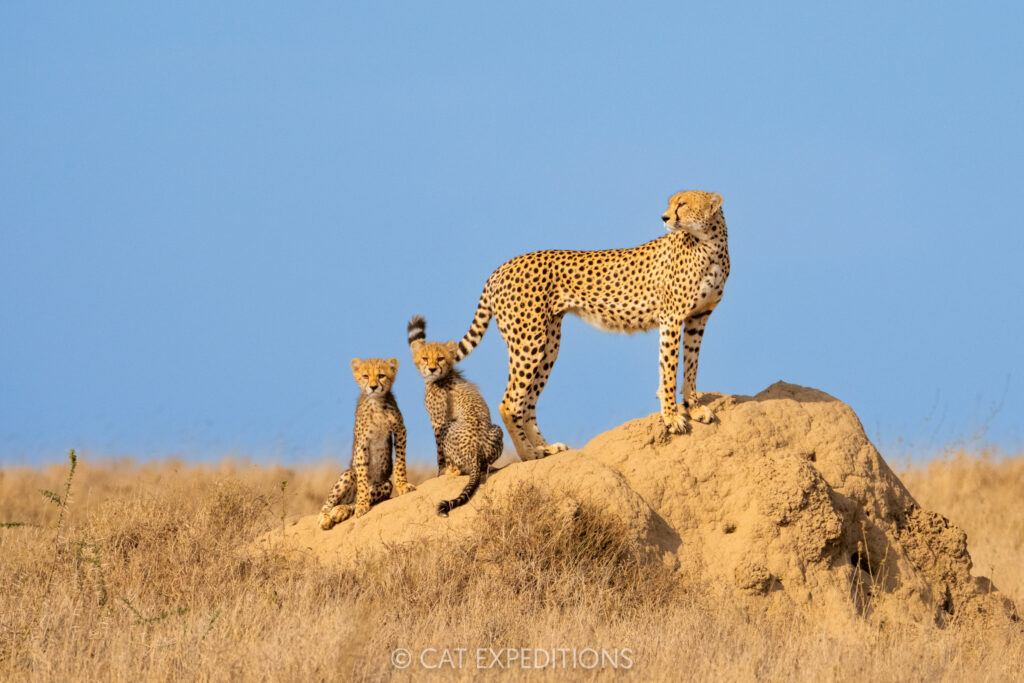
Eventually, the family moved to a termite mound. The mother climbed up first and stood beautifully on top, surveying the plains, perhaps looking for prey, perhaps watching for danger, and probably doing both. The cubs joined her, and for a while all three sat together looking out over the grasslands. Later they moved to another mound and settled there for an extended rest. By then the sun was getting high and the heat was building, so we left them in peace and found a nearby spot for breakfast.
On the long drive back toward camp, our local guide somehow spotted lions sitting on top of a distant rocky kopje. It was another remarkable find. We drove over and once again met the Zebra Pride. The male was absent, but the females and cubs were sprawled together on top of the rounded rock.
The cubs mostly slept while the lionesses remained intensely focused on the surrounding plains. They did not appear to have fed recently, and the females were clearly hungry. One lioness suddenly rose into a stalking posture after spotting a pair of ostriches more than 500 meters away. She eased down off the kopje and disappeared into the tall grass, watching and waiting for around 15 minutes before finally standing again. It was an extremely difficult target, and with no immediate hunt developing, we eventually continued on.
That afternoon, our plan was to return to the kopjes in hopes that the lions might still be nearby. Before we got there, however, we found a herd of roughly 21 elephants, including many very small calves. We stopped and spent close to an hour surrounded by them as they fed calmly all around us.
The younger elephants were particularly entertaining, wrestling and playing with one another while the adults continued feeding. At one point, we watched a calf repeatedly try to steal food directly from its sibling’s mouth. Being able to sit quietly among such a large family group and watch those small social interactions unfold was one of the most special experiences of the day.
Eventually, we continued toward the lions. By the time we reached the area, the pride had left the rocks and was walking in a long line toward the open grasslands. They were clearly focused on something in the distance. The pride had reportedly not eaten for close to a week, and they looked hungry.
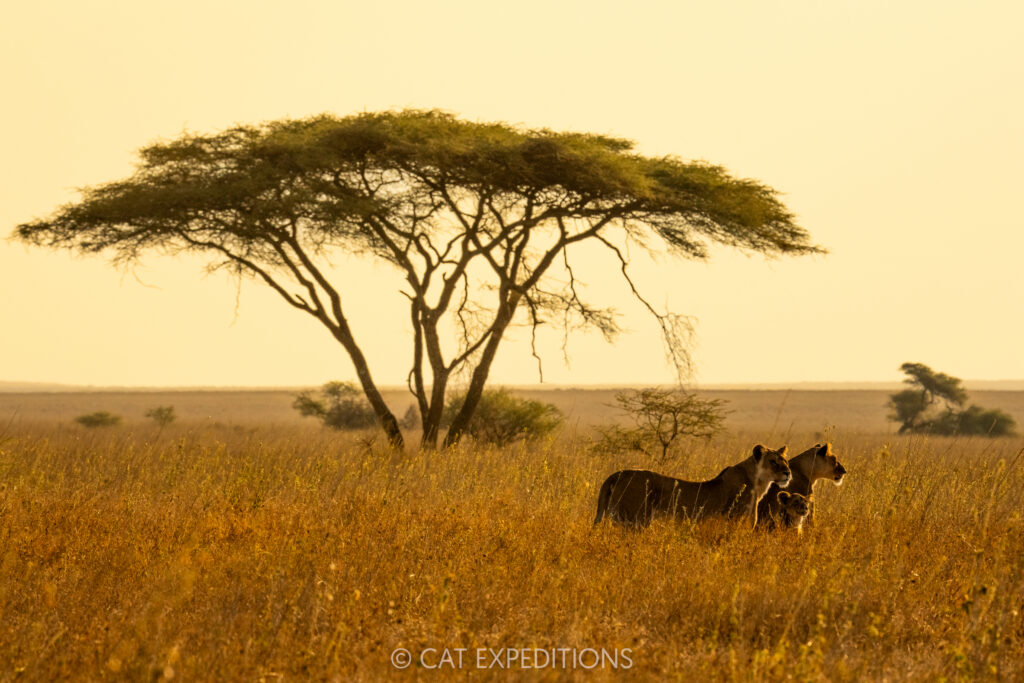
Far across a field of tall grass stood an eland. The lead lioness began moving deliberately in its direction without ever taking her eyes off it. One by one, the other females followed, with the little cubs trailing behind in a loose procession. For more than an hour, we watched the pride slowly work its way across the landscape. An adult eland is a formidable and potentially dangerous target, and the lionesses were clearly taking their time. A meal this large could feed the pride well, but any mistake could also mean injury. As the last light faded, they were still closing the distance, and we eventually had to leave them to continue the hunt on their own.
The drive back to camp somehow became just as memorable. Our local guide spotted a serval hunting just off the road, and we spent some time watching it move through the darkness in our headlights.
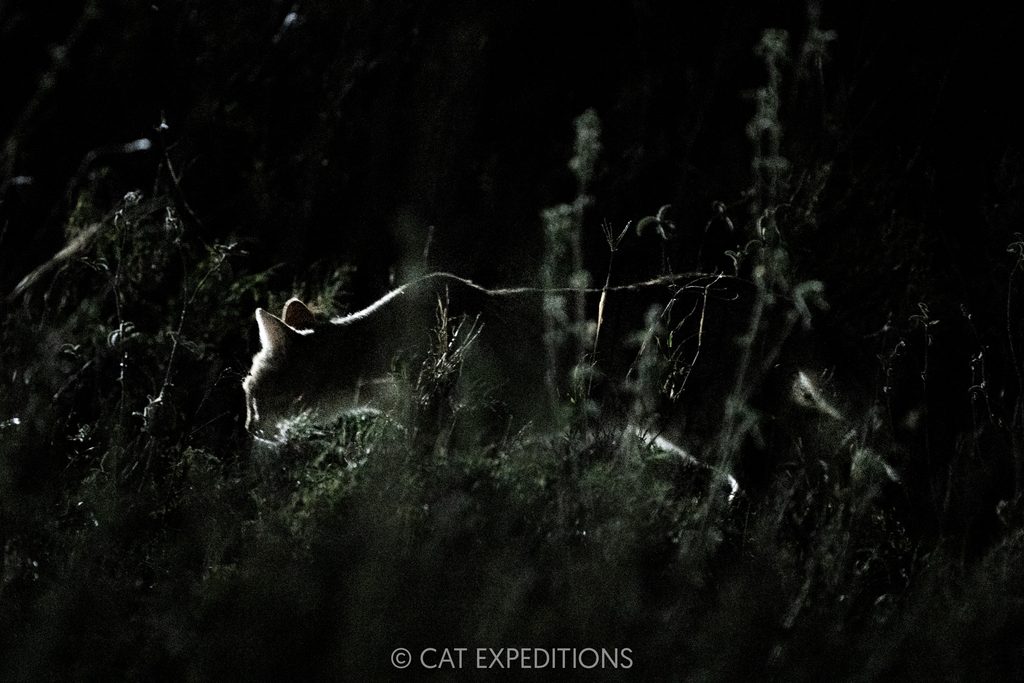
Then, almost back at camp, another cat appeared. This time it was an Afro-Asiatic wildcat—the sixth and final cat species we hoped to see on this trip. At first it remained partly hidden in the vegetation, but importantly, it did not run. We waited quietly, and before long it seemed to relax completely and began hunting.
We followed it with the spotlight as it moved through the grass. At one point, the wildcat walked right up beside the vehicle and began hunting something only a short distance away. After spending so much of the trip searching for small cats, we could hardly believe how cooperative it was.
And then, almost impossibly, the evening delivered one final spectacle. Moments after leaving the wildcat, with everyone still buzzing from the sighting, a brilliant green meteor streaked across the sky above us, breaking apart into fiery fragments as it fell.
After a day of cheetahs, lions, elephants, serval, and finally our sixth cat species, it felt like the Serengeti had decided to give us one last unforgettable show.
Day 7: Our first goal of the morning was to find the Zebra Pride and see whether they had managed to kill the eland we had watched them stalking the evening before. We searched and searched through the tall grass until finally we spotted them—and the answer was immediately obvious.
The lions were sprawled out asleep with enormous, balloon-like bellies. Of the eland, almost nothing remained except the horns and hooves. It was hard to comprehend just how much food the pride had consumed overnight. Even if the eland had been relatively small, the amount each lion must have eaten was extraordinary, and judging by their distended stomachs, none of them was going to be moving very far anytime soon.
We left the very satisfied Zebra Pride and made our way to another part of the Serengeti, where we found the Barafu Pride scattered around a rocky kopje. Four lionesses and several cubs were resting on and around the rocks, while two of the pride males were lying in a nearby gully. The females appeared settled in for the morning, so we decided to go have a look at the males.

While photographing one of the males, we spotted a cheetah several hundred meters out in the grasslands. It was a male, and his attention was completely fixed on the kopje where the lionesses were resting. The lions had noticed him too, and for a while predator watched predator across the plains.
The cheetah clearly understood the danger. He slowly lowered himself into the tall grass, doing everything he could to disappear from view, and then began carefully moving away while keeping an extremely low profile. Once he had put some distance between himself and the lions, we stayed with him as he gracefully crossed the open plains.
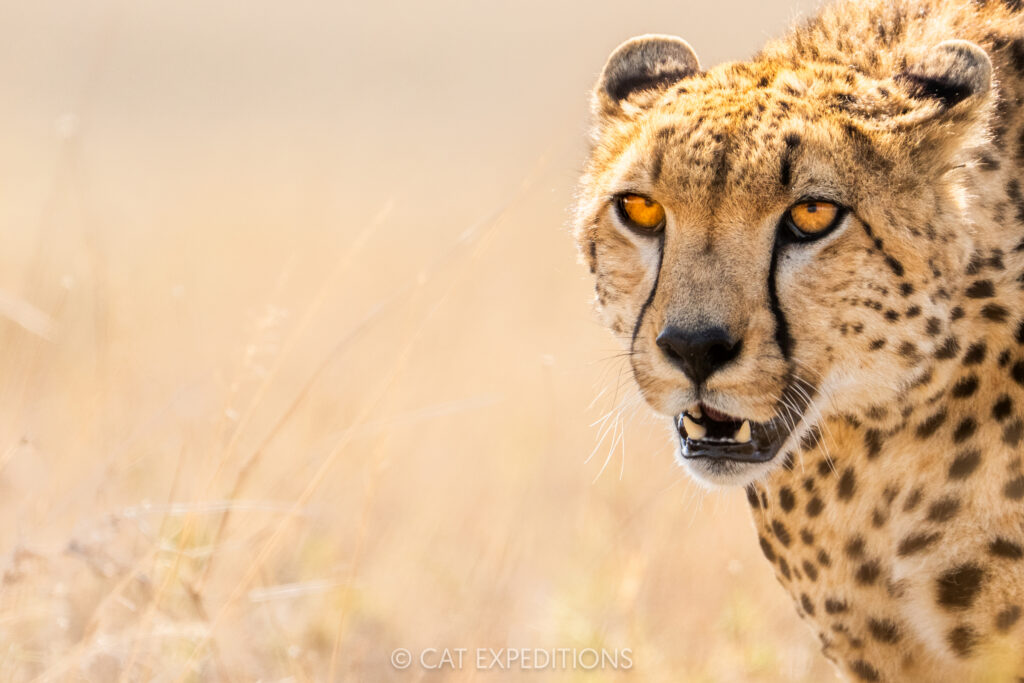
At one point, his passage flushed a group of marsh owls from the grass. Eventually, he stopped and sat upright, scanning the otherwise empty landscape for potential prey. We enjoyed a few more photographs before leaving him to continue his search and heading off for our bush breakfast, where a large herd of zebra provided the backdrop while we ate.
On the drive back toward camp, we added a vervet monkey moving through the yellow fever acacia forest to the morning’s sightings.
That afternoon, we went looking for the elephant family we had spent time with the previous day and were delighted to find them again. Trailing behind the main herd were four bulls, including one enormous older male. The males were remarkably social, gently nuzzling one another and placing their trunks into each other’s mouths as they interacted.
Eventually, they began moving directly toward us. One by one they passed close beside the vehicle, until the huge old bull approached. He came right up to us and extended his trunk in our direction, apparently investigating our scent, before calmly continuing on. It was an extraordinary close encounter with such an impressive animal.
We continued across the plains, scanning for cheetahs and leopards, when we came across one of the smallest animals of the day: a newborn Thomson’s gazelle, probably only a few hours old. Its mother moved away to feed, and the tiny calf instinctively flattened itself into the vegetation. Within moments it seemed to disappear completely in front of us, its camouflage remarkably effective even though we knew exactly where it had gone down.
As the afternoon light softened, we began working our way back toward the area where we had seen the Barafu Pride that morning. We soon found the two males sleeping beneath an acacia tree, just beginning to stir as the landscape turned golden. One of them had a substantial cut on his paw, most likely the result of an altercation with another male.
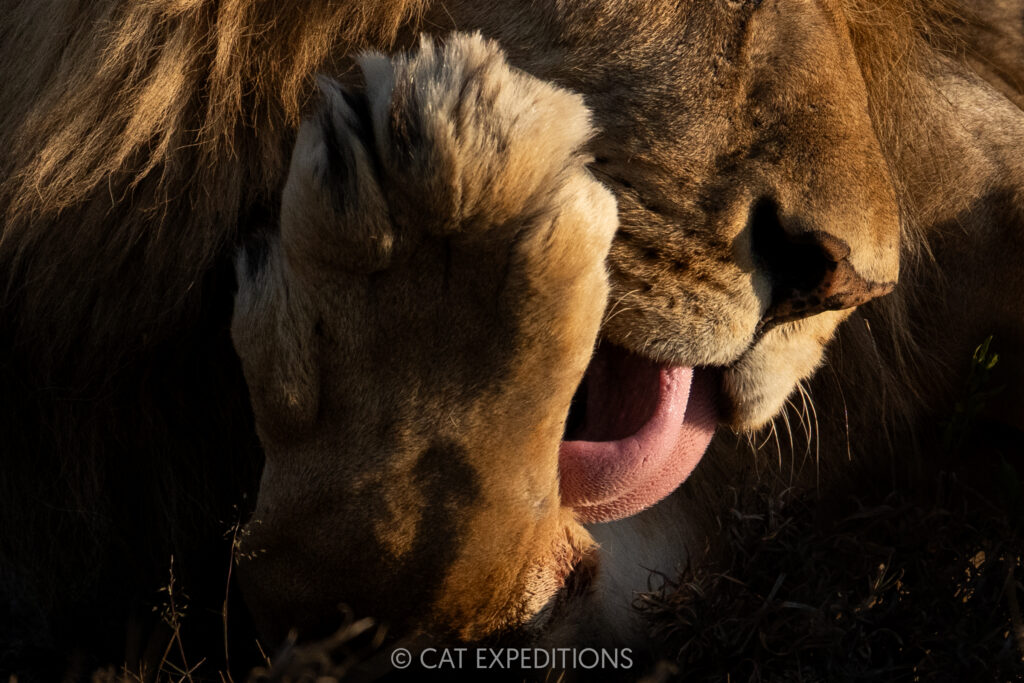
As the light continued to improve, both males finally got to their feet and we were able to get some nice shots of them with the glowing sunset sky behind them!
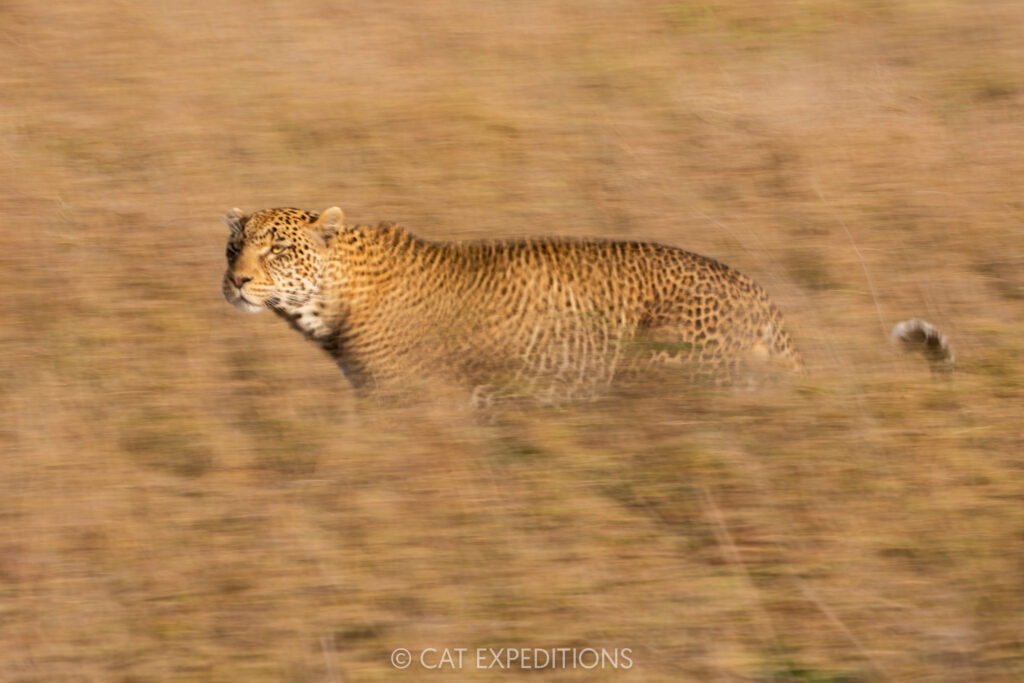
Day 9: Our final day, well, half day really, as we utilized the drive to the airport as our morning game drive. With the most impressive spotting yet, our two local guides saw a male leopard from about a mile away. It was absolutely remarkable. It took us a while to get to him, but we enjoyed beautiful views of him before we had to dart off to the airstrip. What an absolutely incredible time we had in the Serengeti!
Serval and Caracal Photo Tour 2025 Species List
Mammals
| African Elephant | Loxodonta africana |
| African Savannah Hare | Lepus victoriae |
| Cheetah | Acinonyx jubatus |
| African Wildcat | Felis lybica |
| Serval | Leptailurus serval |
| Caracal | Caracal caracal |
| Lion | Panthera leo |
| Leopard | Panthera pardus |
| Egyptian Mongoose | Herpestes ichneumon |
| Banded Mongoose | Mungos mungo |
| Spotted Hyena | Crocuta crocuta |
| African Golden Wolf | Canis lupaster |
| Side-striped Jackal | Lupulella adusta |
| Black-backed Jackal | Lupulella mesomelas |
| Bat-eared Fox | Otocyon megalotis |
| Plains Zebra | Equus quagga |
| Common Warthog | Phacochoerus africanus |
| Hippopotamus | Hippopotamus amphibius |
| Masai Giraffe | Giraffa tippelskirchi |
| Coke’s Hartebeest | Alcelaphus buselaphus cokei |
| Blue Wildebeest | Connochaetes taurinus |
| Topi | Damaliscus lunatus |
| Grant’s Gazelle | Nanger granti |
| Thomson’s Gazelle | Eudorcas thomsonii |
| Kirk’s Dik-dik | Madoqua kirkii |
| Steenbok | Raphicerus campestris |
| Cape Buffalo | Syncerus caffer |
| Common Eland | Taurotragus oryx |
| Bohor Reedbuck | Redunca redunca |
Birds
| Common Ostrich | Struthio camelus |
| Egyptian Goose | Alopochen aegyptiaca |
| Red-billed Duck | Anas erythrorhyncha |
| Coqui Francolin | Francolinus coqui |
| Gray-breasted Spurfowl | Pternistis rufopictus |
| Speckled Pigeon | Columba guinea |
| Namaqua Dove | Oena capensis |
| Chestnut-bellied Sandgrouse | Pterocles exustus |
| Yellow-throated Sandgrouse | Pterocles gutturalis |
| Kori Bustard | Ardeotis kori |
| White-bellied Bustard | Eupodotis senegalensis |
| Black-bellied Bustard | Lissotis melanogaster |
| White-browed Coucal | Centropus superciliosus |
| Spotted Thick-knee | Burhinus capensis |
| Black-winged Stilt | Himantopus himantopus |
| Three-banded Plover | Charadrius tricollaris |
| Blacksmith Lapwing | Vanellus armatus |
| Crowned Lapwing | Vanellus coronatus |
| Greater Painted-Snipe | Rostratula benghalensis |
| African Jacana | Actophilornis africanus |
| Double-banded Courser | Smutsornis africanus |
| Temminck’s Courser | Cursorius temminckii |
| White-winged Tern | Chlidonias leucopterus |
| African Openbill | Anastomus lamelligerus |
| Marabou Stork | Leptoptilos crumenifer |
| Western Cattle Egret | Bubulcus ibis |
| Black-headed Heron | Ardea melanocephala |
| Secretarybird | Sagittarius serpentarius |
| Black-winged Kite | Elanus caeruleus |
| Lappet-faced Vulture | Torgos tracheliotos |
| Bateleur | Terathopius ecaudatus |
| Black-chested Snake Eagle | Circaetus pectoralis |
| Brown Snake Eagle | Circaetus cinereus |
| Martial Eagle | Polemaetus bellicosus |
| Steppe Eagle | Aquila nipalensis |
| Tawny Eagle | Aquila rapax |
| Pallid Harrier | Circus macrourus |
| Montagu’s Harrier | Circus pygargus |
| Barn Owl | Tyto alba |
| Spotted Eagle Owl | Bubo africanus |
| Verreaux’s Eagle Owl | Bubo lacteus |
| Marsh Owl | Asio capensis |
| Speckled Mousebird | Colius striatus |
| African Gray Hornbill | Tockus nasutus |
| European Bee-eater | Merops apiaster |
| European Roller | Coracias garrulus |
| Lilac-breasted Roller | Coracias caudatus |
| D’Arnaud’s Barbet | Trachyphonus darnaudii |
| Pygmy Falcon | Polihierax semitorquatus |
| Lesser Kestrel | Falco naumanni |
| Greater Kestrel | Falco rupicoloides |
| Fischer’s Lovebird | Agapornis fischeri |
| Slate-colored Boubou | Laniarius funebris |
| Fork-tailed Drongo | Dicrurus adsimilis |
| Lesser Gray Shrike | Lanius minor |
| Gray-backed Fiscal | Lanius excubitoroides |
| Magpie Shrike | Corvinella melanoleuca |
| White-rumped Shrike | Eurocephalus ruppelli |
| Cape Crow | Corvus capensis |
| Common Bulbul | Pycnonotus barbatus |
| Pale White-eye | Zosterops flavilateralis |
| Black-lored Babbler | Turdoides sharpei |
| Hildebrandt’s Starling | Lamprotornis hildebrandti |
| Superb Starling | Lamprotornis superbus |
| Silverbird | Melaenornis semipartitus |
| Sooty Chat | Myrmecocichla nigra |
| Isabelline Wheatear | Oenanthe isabellina |
| Collared Sunbird | Hedydipna collaris |
| Red-billed Buffalo-Weaver | Bubalornis niger |
| White-headed Buffalo Weaver | Dinemellia dinemelli |
| White-browed Sparrow-Weaver | Plocepasser mahali |
| Rufous-tailed Weaver | Histurgops ruficauda |
| Red-billed Quelea | Quelea quelea |
| Purple Grenadier | Granatina ianthinogaster |
| African Pied Wagtail | Motacilla aguimp |
| Yellow-throated Longclaw | Macronyx croceus |