Andean Mountain Cat
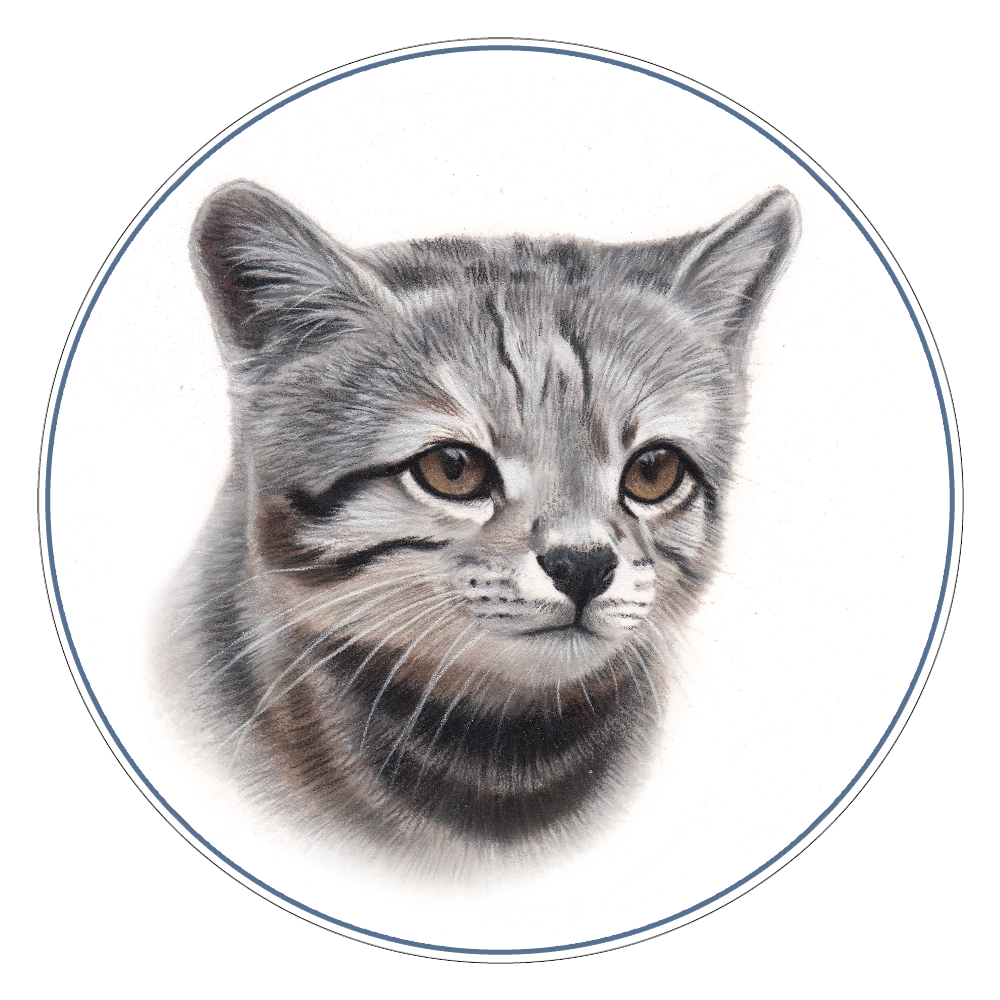
ANDEAN MOUNTAIN CAT (Leopardus jacobita)
The Andean mountain cat is one of the rarest and least-known wild cats in the world. Found primarily in the high Andes of Argentina, Bolivia, Chile, and Peru, these small cats live in some of the harshest environments occupied by any feline. They are closely associated with rocky landscapes and their primary prey, the mountain viscacha. Fewer than 2,500 mature individuals are estimated to remain in the wild, and the species is classified as Endangered.
Difficulty: Extremely Difficult
Andean Mountain Cat Photo Tour Statistics

1 ANDEAN MOUNTAIN CAT
TOUR RUN

2 AVG NUMBER OF CATS SEEN PER TOUR

1 MINUTE ON AVG
WITH EACH CAT
Andean Mountain Cat Description
The Andean mountain cat is a small but stocky feline, weighing approximately 4–6 kg (9–13 lbs), making it roughly twice the size of a typical domestic cat. Its incredibly thick coat is an adaptation to the cold, harsh conditions of the high Andes. The fur is predominantly silvery-grey, patterned with brownish-yellow to dark grey blotches and stripes along the sides of the body.
Perhaps the cat's most distinctive feature is its enormous, bushy tail. Measuring 41–48 cm (16–19 inches), the tail can be approximately three-quarters the length of the cat's head and body and is marked by six to nine broad, dark rings. The long tail likely helps the cats balance as they move and hunt among steep cliffs and boulder fields.
Andean mountain cats can sometimes be confused with pampas cats, which occur in the same habitat. Andean cats are generally larger, have a much longer and thicker tail, and have a black nose, compared with the typically pinkish nose of a pampas cat.
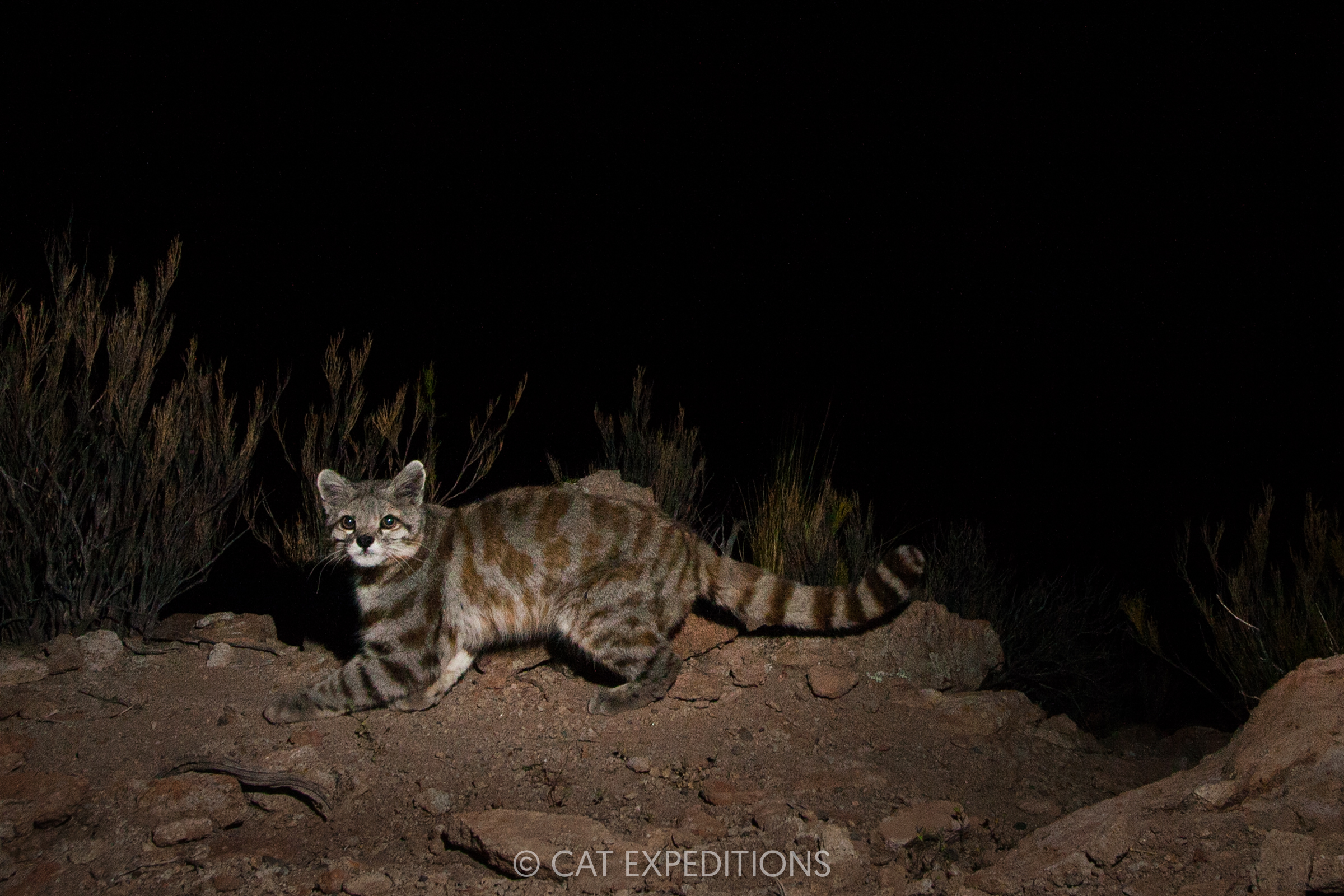
Andean Mountain Cat at night, showing that characteristic long, thick tail and black nose.
Andean Mountain Cat Distribution and Habitat
Andean mountain cats are found in Argentina, Bolivia, Chile, and Peru. They are primarily associated with the high Andes, where they have been recorded at elevations exceeding 5,000 meters (16,400 feet). During our Andean mountain cat tour we primarily look for the cat around 14,000 feet. However, discoveries in recent decades have dramatically expanded our understanding of their distribution, with Andean cats now known from portions of the Patagonian steppe as low as approximately 650 meters (2,130 feet).
Throughout much of their range, however, these cats inhabit an extraordinary landscape of high-elevation desert, rocky slopes, cliffs, volcanic formations, sparse grasslands, and high-Andean wetlands known as bofedales. Temperatures can change dramatically between day and night, vegetation is sparse, and winters can be bitterly cold.
One of the most important features of Andean cat habitat is rock. Boulder fields, cliffs, and rocky outcroppings provide shelter for the cats, but they are also home to mountain viscachas—the Andean cat's primary prey. As a result, the distribution of the cat appears to be closely tied to the availability of both rocky habitat and viscachas.
Andean cats naturally occur at extremely low densities. One camera-trap study in northwestern Argentina estimated densities of only 7–12 Andean cats per 100 square kilometers. Their dependence on naturally fragmented rocky habitat means populations can be widely separated from one another.
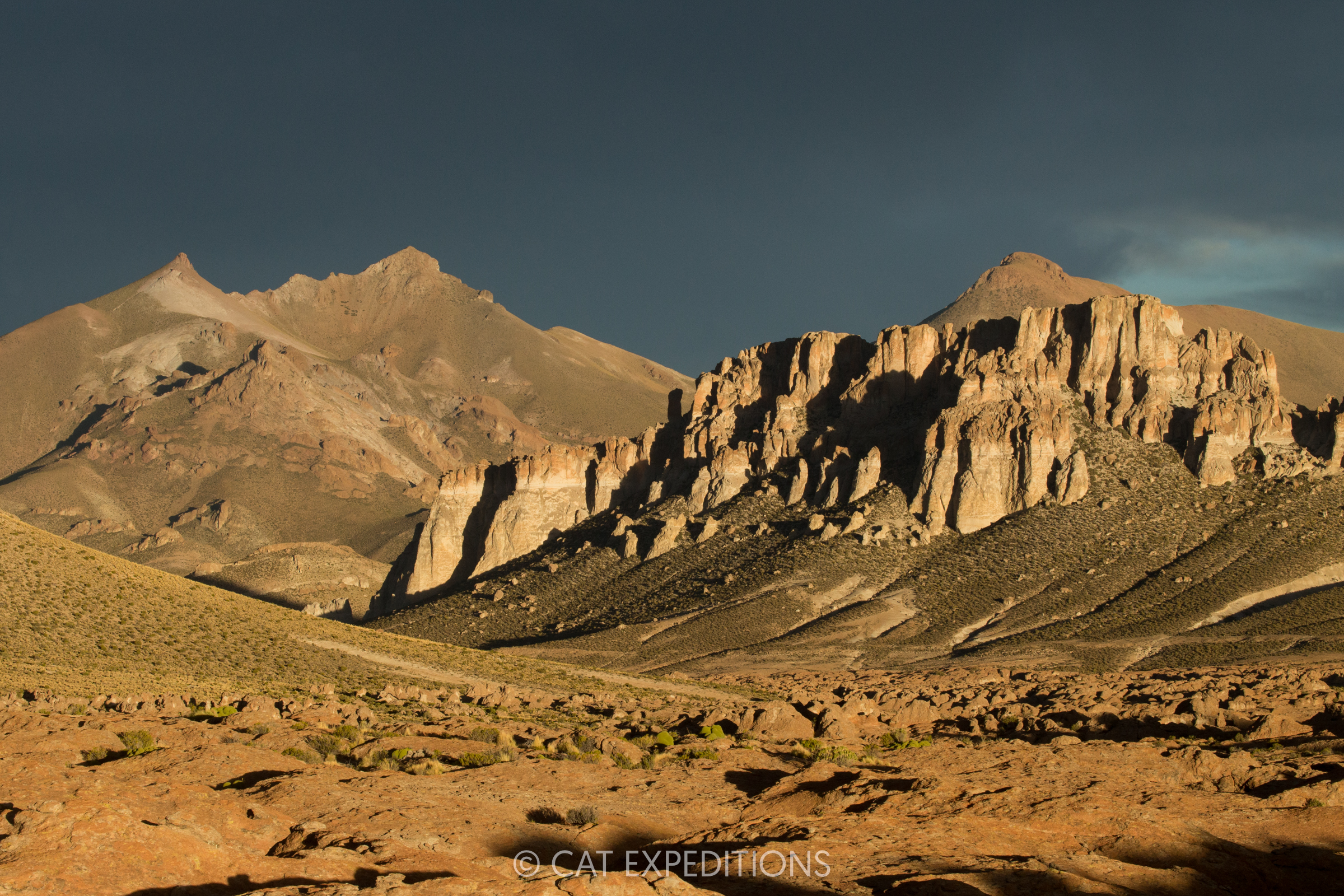
Peaks and rock formations in dry puna, showing perfect Andean Mountain Cat habitat, Andes, northwestern Argentina
Andean Mountain Cat Feeding Biology
The Andean mountain cat is a specialist predator with a particularly strong association with mountain viscachas. These rabbit-sized rodents live in colonies among cliffs and boulder fields throughout the Andes and can represent the majority of the biomass consumed by Andean cats.
This relationship may help explain why Andean cats are so closely associated with rocky landscapes: the same cliffs and boulder fields that provide the cats with shelter also support colonies of their most important prey.
Andean cats aren't completely dependent on viscachas, however. Studies of their diet have also found numerous smaller rodents, birds, waterfowl, reptiles, and even insects. Historically, chinchillas may also have been an important prey species before populations were decimated by the fur trade.
Interestingly, the Andean cat's daily activity appears to overlap considerably with that of mountain viscachas. Camera-trap research in the high Andes found Andean cats to be more active during daylight than the sympatric pampas cat, although more recent research and telemetry have also documented substantial crepuscular and nighttime activity. Their activity patterns may therefore vary between regions and seasons depending on prey activity and local conditions.
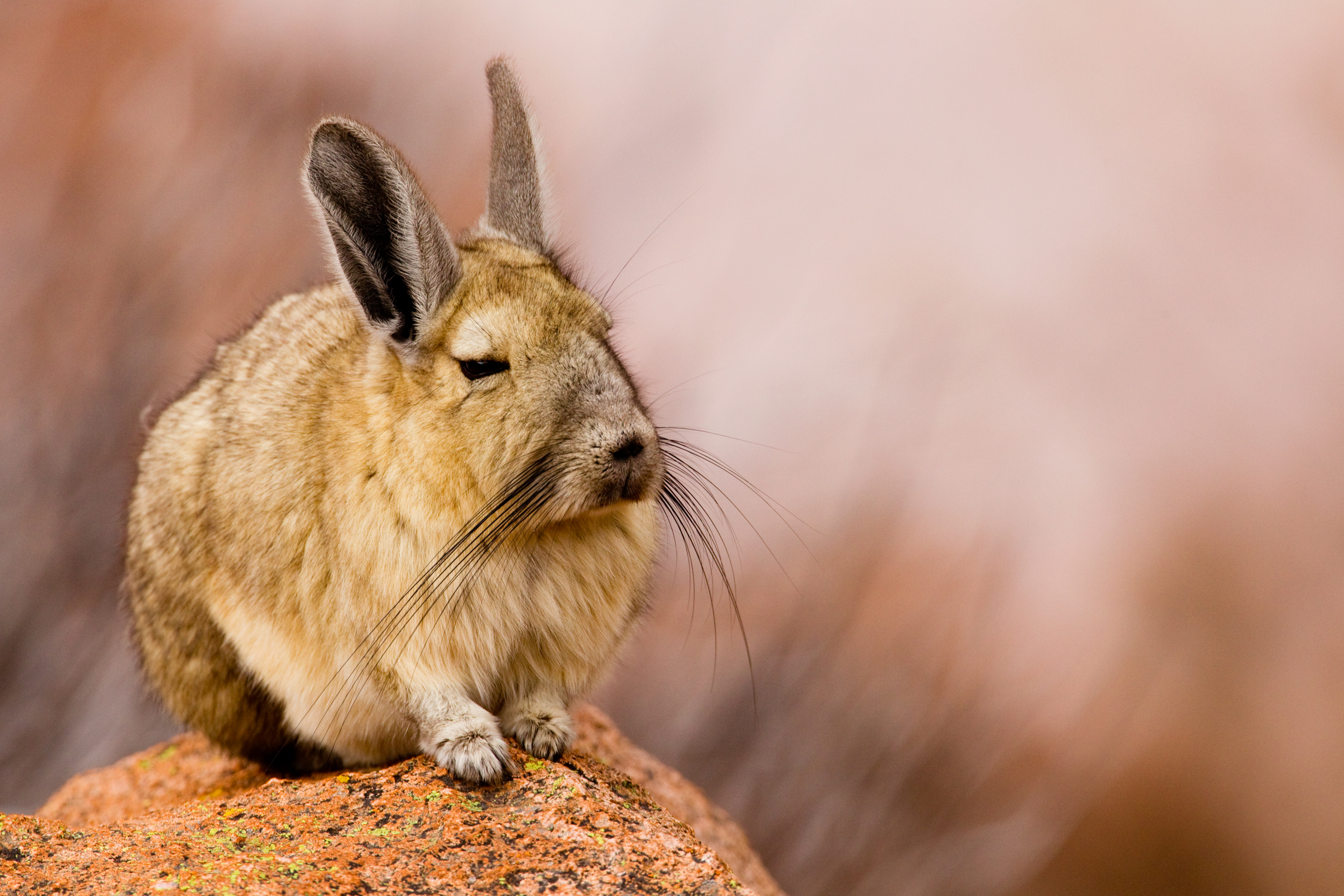
Southern Viscachas are a preferred prey item for the Andean cat, and the two are closely linked in habitat. Chinchillas used to be a major prey item before the pet trade decimated their numbers.
Andean Mountain Cat Social Organization
Very little is known about the social lives of Andean mountain cats. Like most small wild cats, they are believed to be predominantly solitary, although pairs are obviously observed during the breeding season.
Their home ranges appear to be remarkably large for such a small cat, probably reflecting the low productivity and fragmented nature of their high-altitude environment. Studies have reported individual home ranges of several dozen square kilometers, with some estimates approaching or exceeding 60 square kilometers.
This enormous space requirement, combined with naturally low population densities and fragmented habitat, means individual Andean cats may be separated by considerable distances. In one camera-trap study in Argentina, Andean cats were approximately six to ten times less abundant than pampas cats living in the same landscape.
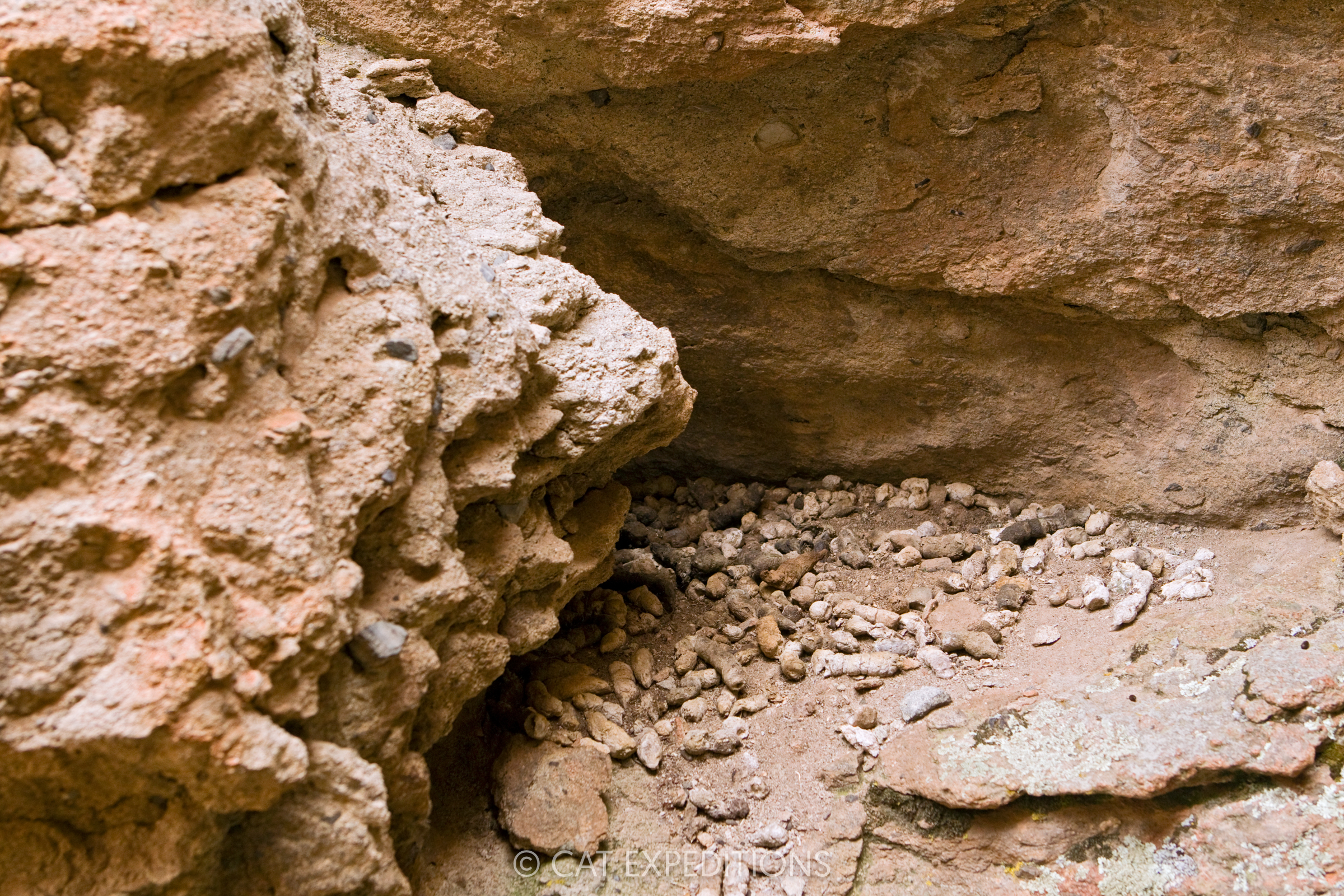
Andean mountain cats, like many of the species in the Leopardus genus, latrine. This means they go to the bathroom in the same spot over and over again. Why they do this still remains a mystery.
Andean Mountain Cat Reproduction
Reproduction remains one of the least understood aspects of Andean mountain cat biology. Even basic information such as gestation length and the normal litter size is still poorly known.
Camera-trap records and observations of kittens suggest that births may be concentrated during particular periods of the year, but there is not yet enough information to establish a well-defined breeding season across the species' enormous range. Females with single kittens have been documented, and the IUCN/SSC Cat Specialist Group currently lists a litter size of one, although the small number of observations means we still have much to learn about their reproductive biology.
The fact that such fundamental aspects of the life history of a wild cat remain unknown illustrates just how little studied the Andean mountain cat is.
Andean Mountain Cat Conservation
The Andean mountain cat is classified as Endangered by the IUCN. The most recent assessment estimates approximately 4,354 Andean cats in total, including around 2,177 mature individuals, with no known subpopulation believed to contain more than 250 mature cats.
Habitat loss and degradation are among the greatest threats to the species. Mining is an especially serious concern throughout the Andes, where extraction of lithium, copper, gold, and other minerals can result in habitat destruction, road construction, increased traffic, water extraction, pollution, and growing human presence in previously remote areas. Much of the cat's most suitable habitat overlaps the so-called "lithium triangle" of Argentina, Bolivia, and Chile.
Other threats include hunting, retaliatory killing, declining prey populations, attacks by domestic dogs, and potentially the transmission of disease from domestic dogs and cats. Climate change represents another long-term threat, as changing conditions could push suitable habitat farther upslope and further isolate already fragmented populations.
Despite these challenges, conservation efforts are underway throughout the species' range. The Andean Cat Alliance works across Argentina, Bolivia, Chile, and Peru to research the species, protect habitat, reduce human-caused mortality, work with local communities, and better understand one of the world's least-known wild cats.
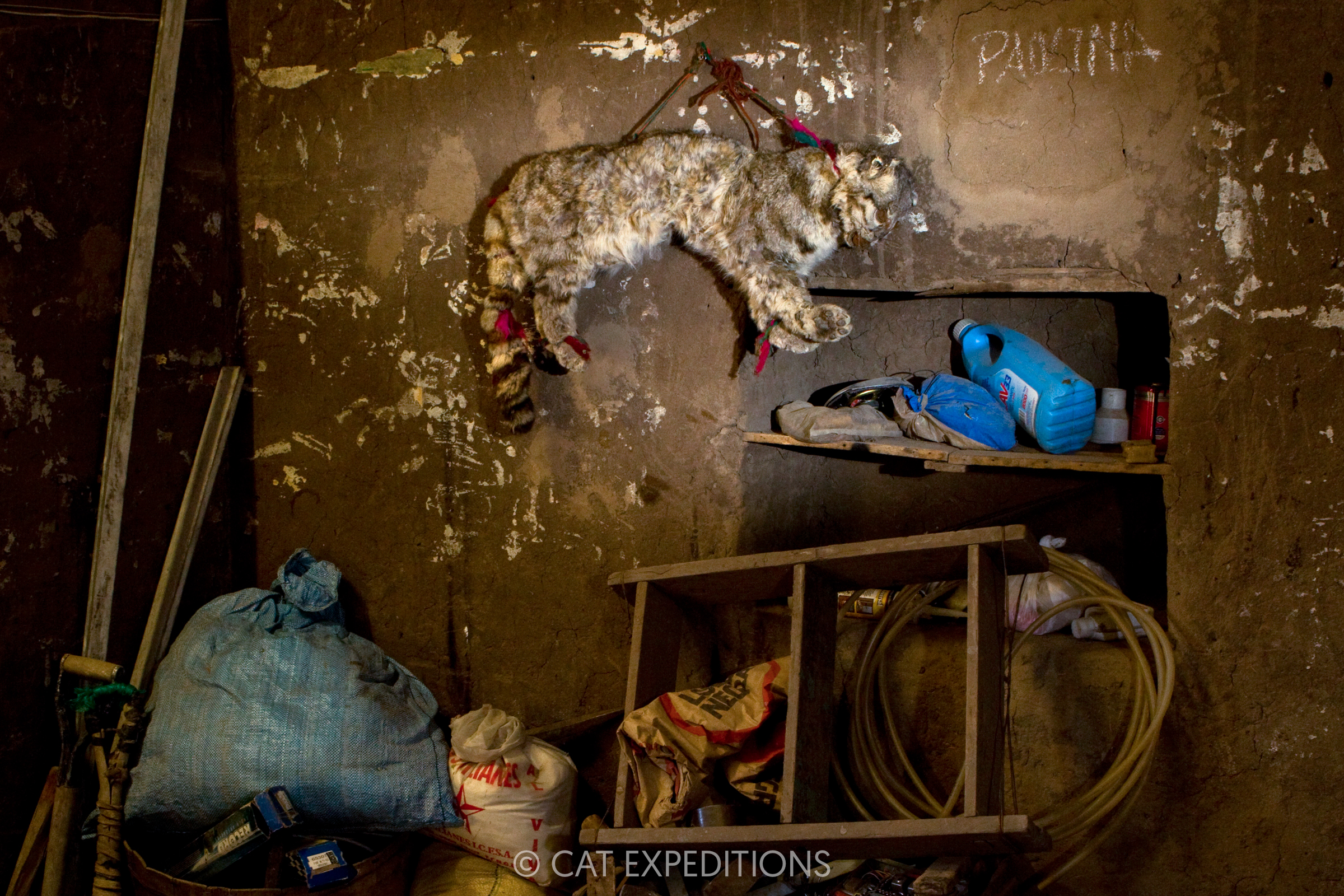
Many people believe a dead Andean cat hung in their homes brings good luck for the harvest in the future, and serves as a direct threat to the survival of the cat.