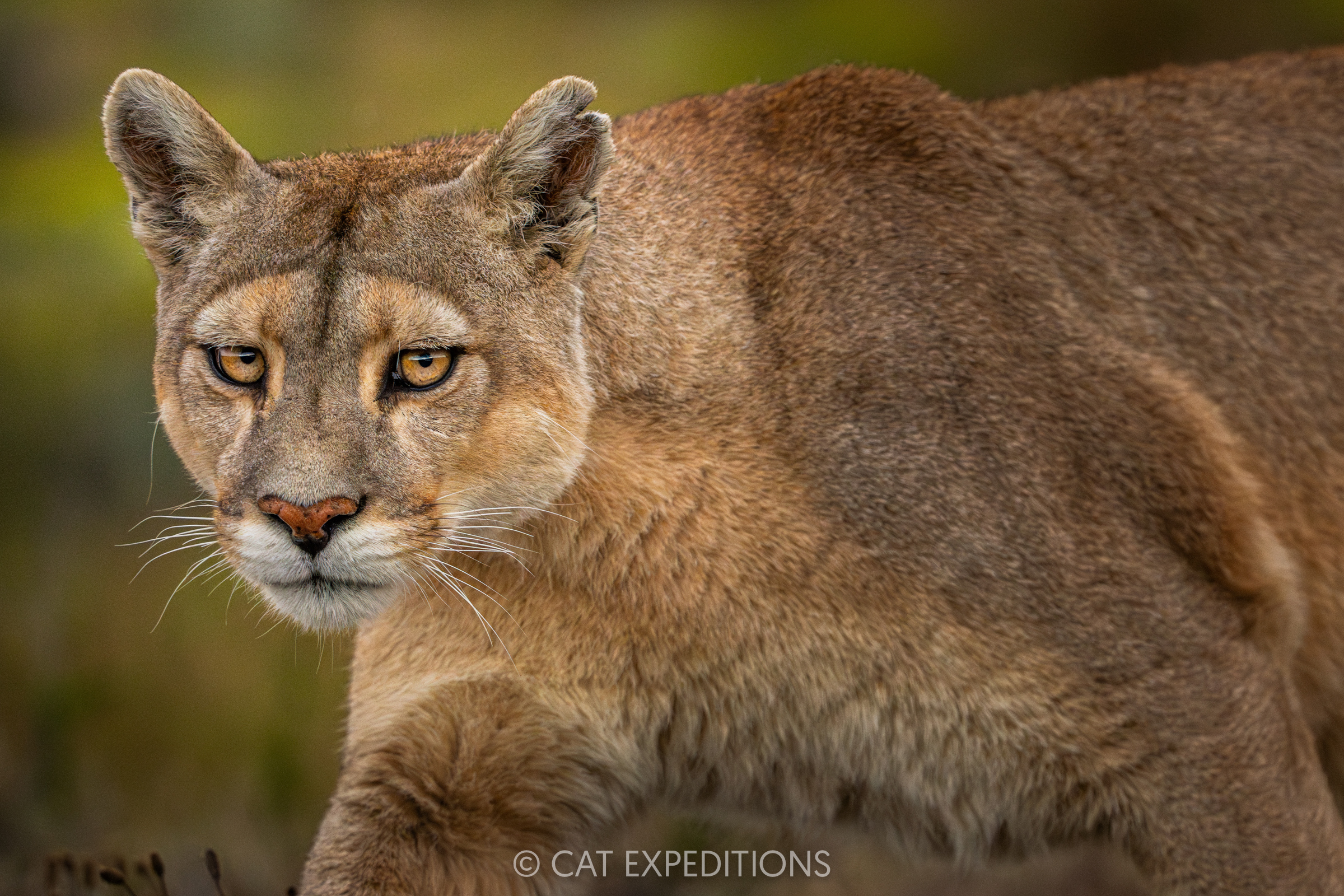
In December of 2025, we returned for our annual pumas of Patagonia photo tour. Check out all the photos and stories in our Pumas of Patagonia Photo Tour 2025 Trip Report below! The words here are largely due to the excellent notes taken by guest Lisa Antell!
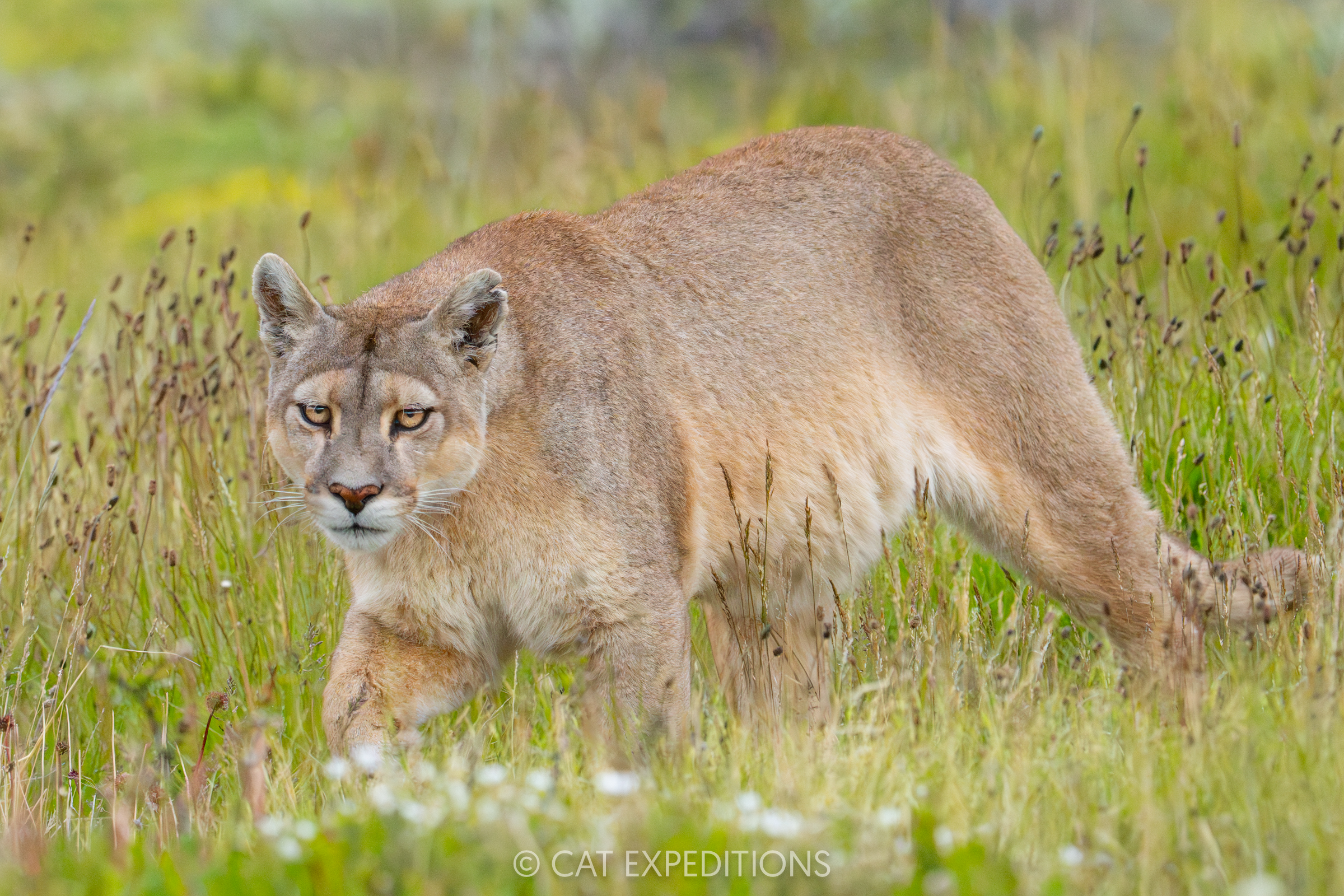
Highlights of the 2025 Puma Photo Tour
Pumas (Dania): We saw four different individual pumas, with our longest sighting being with Dania, who we spent a few hours with, as she moved through the pre-Andean scrubland.
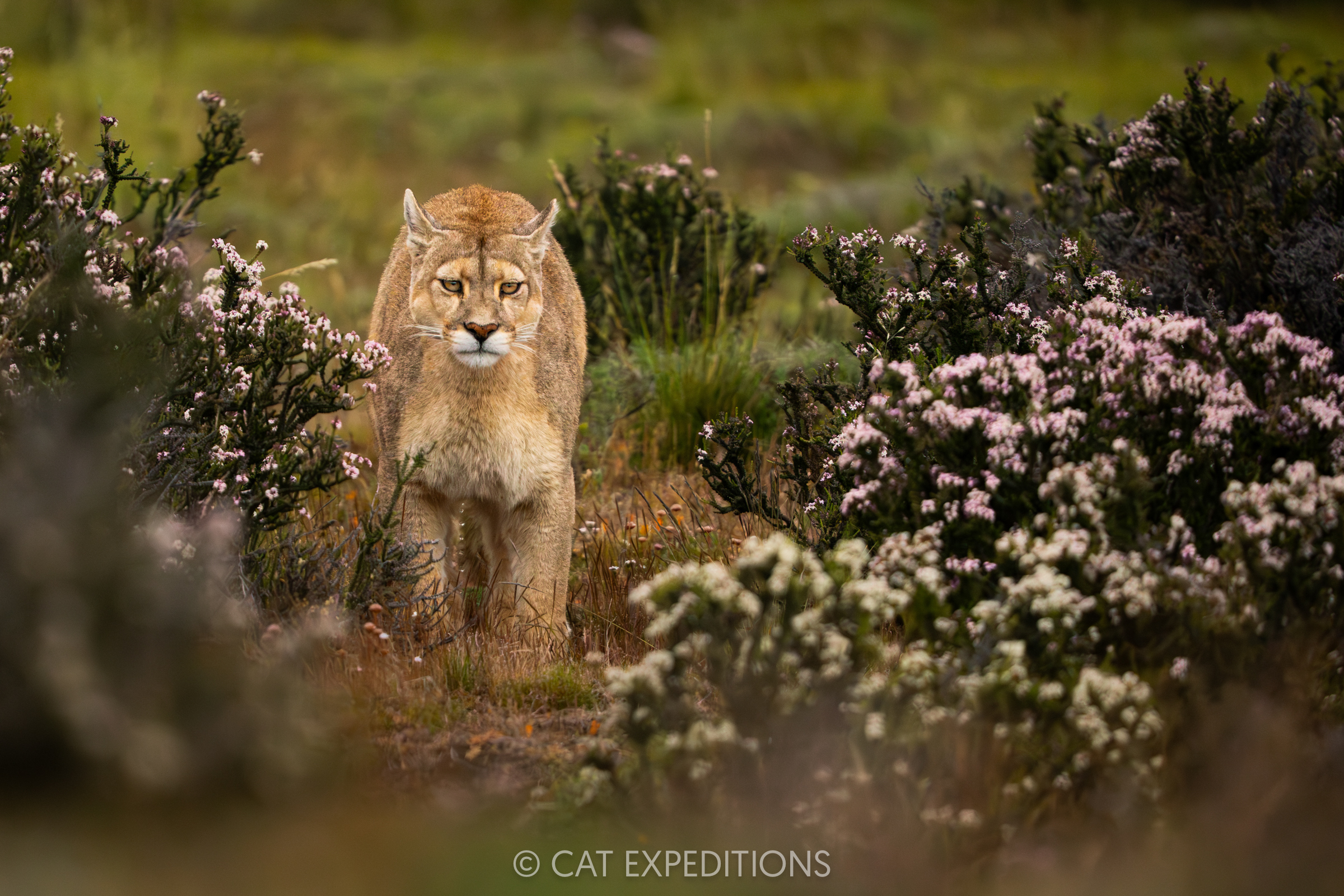
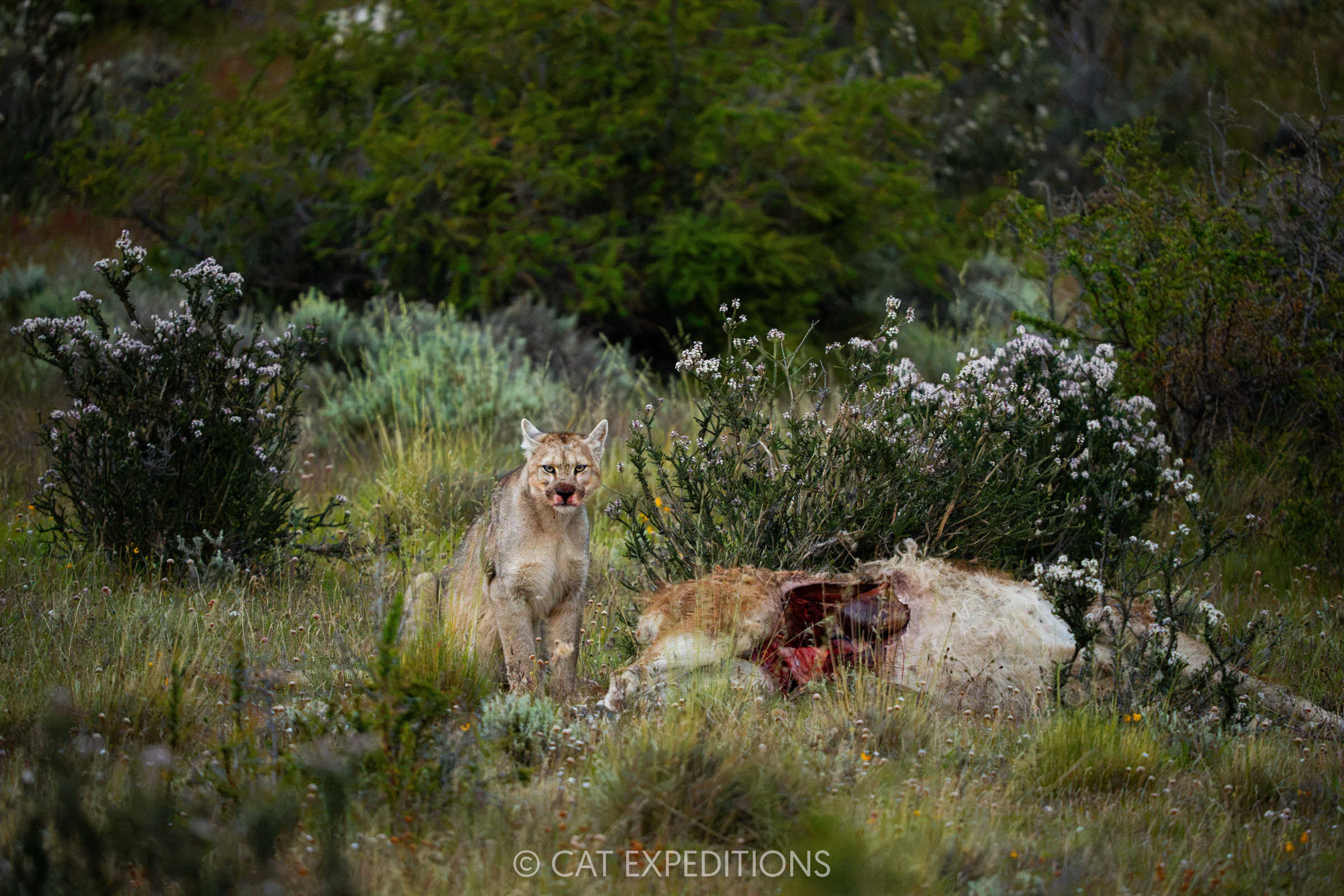
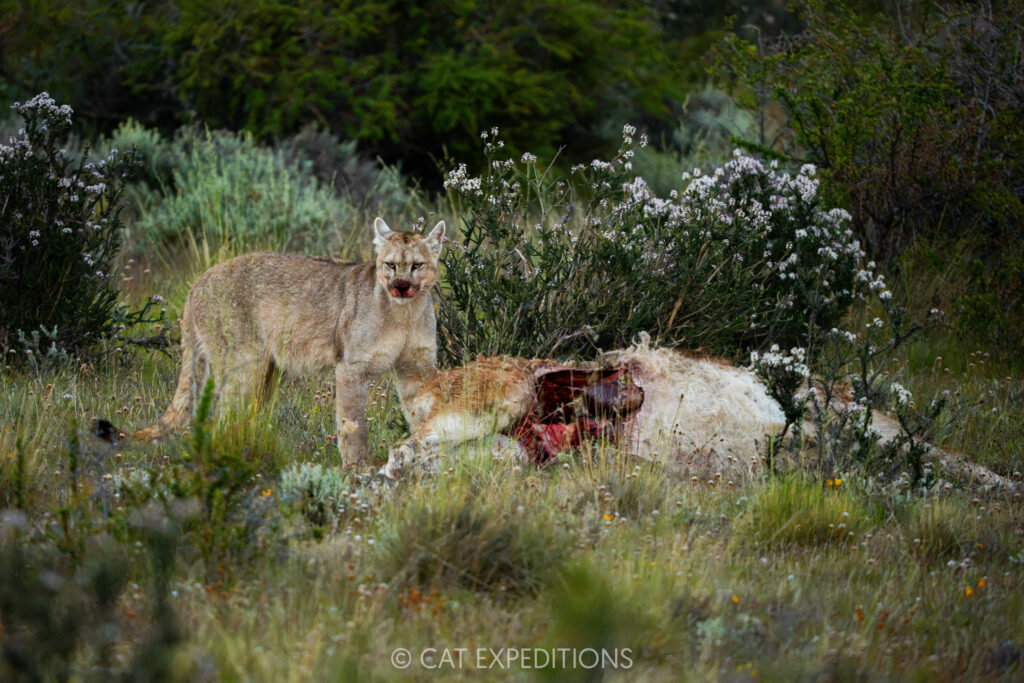
Pumas (Petaka): Oh Petaka, we love her so much, having known her since a cub. We saw her two consecutive days as she mostly relaxed with a baby guanaco kill she was very slowly feeding on.
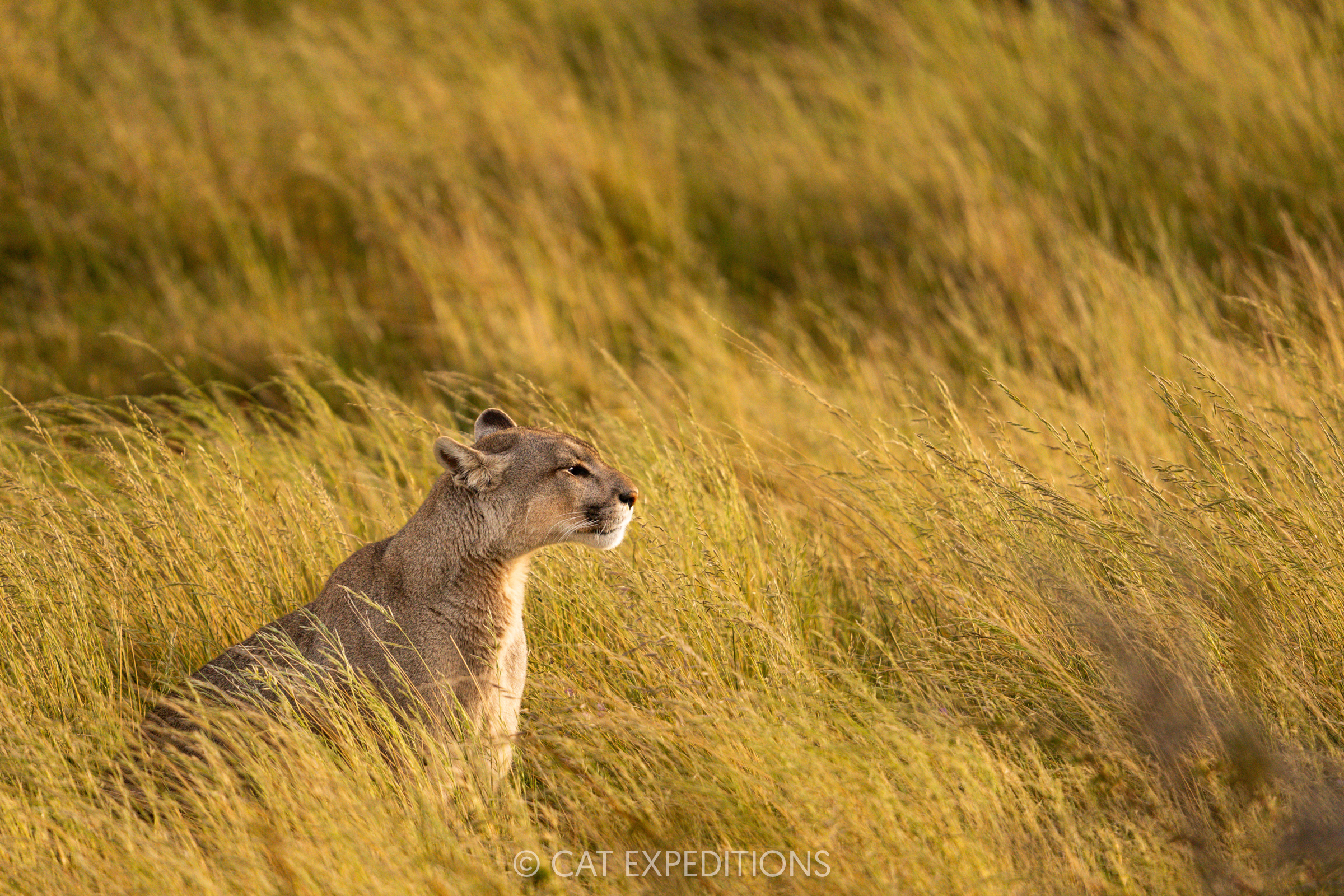
Pumas (Nieve and Copito): We finished our puma trip with a wonderful sighting of Nieve and her cub Copito. We had never seen Nieve before so it felt like a real treat.
Detailed Pumas of Patagonia Photo Tours 2025 Summary
Day 1: Some of our guests had spent the night, others arrived today at Hotel Simple in Puerto Natales, a beautiful lodge set right on the water with sweeping views across the surrounding landscape. We gathered for another quick breakfast and a chance to catch up before officially beginning the trip.
Our first briefing was scheduled for 11:00 a.m., and before everyone assembled, there was time to simply enjoy the view—and, perhaps just as importantly, spend a little time with one of the lodge’s resident tabby cats. She was warm, sleepy, and more than happy to be cuddled. In fact, there were several wonderfully friendly cats wandering around the property, which felt like an appropriate way to begin a trip dedicated to their much larger Patagonian relatives.
At 1:00 p.m. we left Hotel Simple and drove to the nearby home of our main local guide, for a traditional barbecue lunch. Our guide welcomed us into a fantastic open dining area centered around a huge grill, with an impressive spread of food already being prepared. His young shepherd dog was equally enthusiastic about our arrival.
Lunch became a feast of salads, vegetables, and beautifully prepared beef served around a large communal table.
At 4:15 p.m., our van picked us up for the drive to Cerro Guido, where we would be staying for the puma portion of the trip. The landscape along the way was stunning. Everything was intensely green, fresh snow still capped the surrounding mountains, and purple lupines and other wildflowers covered the roadside. Despite the overcast skies, the weather was mild and surprisingly calm for Patagonia.

We arrived at Cerro Guido around 6:00 p.m. The estancia sits in a spectacular setting, with expansive views toward the Towers of Paine, Lago Sarmiento, and the surrounding Patagonian steppe. We checked into rooms in the beautifully restored old main house before gathering around a gaucho campfire at 7:00 p.m.
Dinner followed in the main dining room at 7:30, bringing our arrival day to a close. With the briefings finished, the group assembled, and the Patagonian landscape spread out around us, we were ready to begin searching for pumas the following morning.
Day 2: Our first full day in Patagonia began early. We left the lodge at 4:40 a.m. in the predawn chill, though thankfully it wasn’t brutally cold. Almost immediately, we had our first wildlife sighting of the day when a Patagonian fox appeared in the lodge parking area under the beam of a spotlight.
We drove toward the puma area, about half an hour away, with our puma tracker already out there. In the low light, we stopped often to scan. The sunrise seemed to last forever, with beautiful clouds catching the first light over the mountains and valleys below.
At one of our stops, our spotter picked out another Patagonian fox standing on a broken rocky slope. She was beautifully positioned in the early sun, surrounded by rock, scrub, wildflowers, and fresh green vegetation. After posing for a while, she disappeared down into a cleft between the boulders, making us wonder if there might be a den hidden among the rocks. As we began to move on, she reappeared and gave us another look in the soft light before suddenly becoming alert and moving quickly downslope and along the road, as if she had picked up on something and was actively hunting.
We continued through the hills, seeing a hare dash along the road and guanacos scattered across the landscape. The routine became one of driving, stopping, scanning, and moving on, using binoculars whenever the terrain looked promising.
Eventually, we dropped down toward Lago Sarmiento and met up with the other vehicles and spotters for a quick break. No one else had found a puma yet, so our fox encounters remained the highlight of the morning.
From there, we continued along the road beside Lago Sarmiento through some of the most beautiful scenery of the trip. The hills were intensely green and covered in wildflowers. Our local guide told us that the peak bloom only lasts a week or two, making us realize how lucky we were to have arrived at exactly the right time.
As we began heading back toward the main highway, a call came in that a puma had been seen near the road into Amarga. We drove over quickly, but by the time we arrived, the cat—a shy collared female with a kitten—had moved into thick cover. With a number of vehicles already gathered and the pumas clearly uncomfortable, we decided not to push the sighting and continued back toward the lodge.
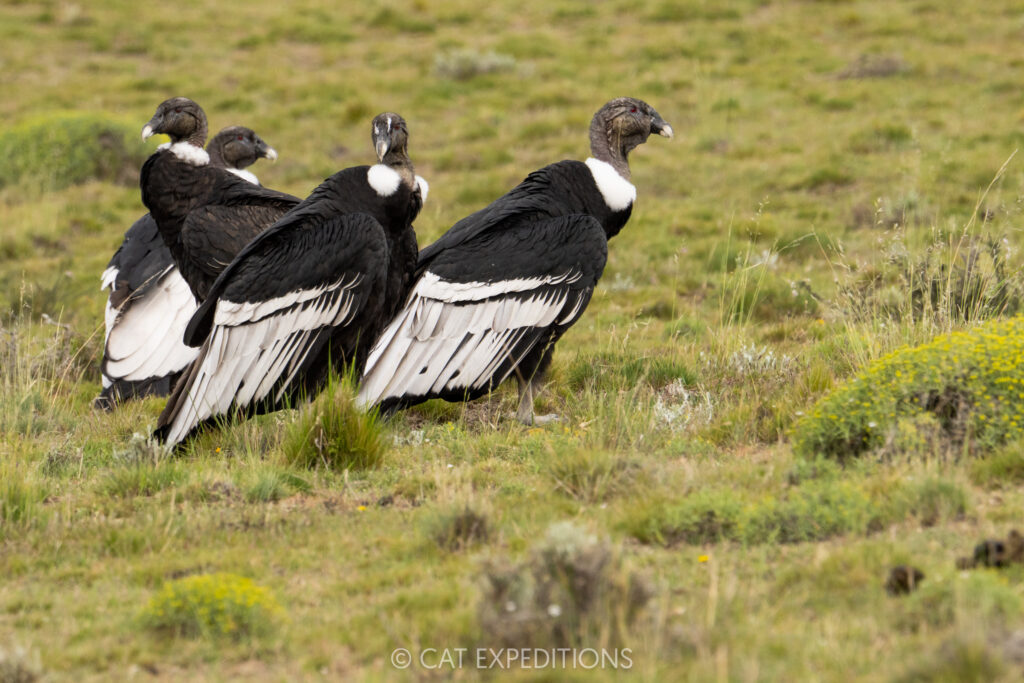
On the highway, we came across another dramatic scene: five Andean condors gathered on the ground near a dead guanaco along the fence line. We got out to photograph them, and while we were there, a couple more Patagonian foxes moved through the surrounding vegetation. We finally made it back to the lodge around 11:00 a.m.
After lunch and a Lightroom session in the afternoon, we headed out again at 5:30 p.m. The landscape felt completely different in the evening light. Flowering shrubs and plants were everywhere, especially black bush, whose strong fragrance filled the air and gave the steppe that unmistakable Patagonian smell.
We drove straight back toward Amarga after getting word that Petaka, a female puma, had been found on a kill. Reaching her meant hiking across two ridges, but when we arrived she was resting beneath a thicket with a baby guanaco kill nearby. Most of the time we could only see her ears or an occasional glimpse of her face through the grass and shadows.
A pair of birds repeatedly alarm-called at her for quite some time before finally moving off. Nearby, a lone female guanaco stood watching. She may have been the mother of the calf. For a long time she remained silent, then gradually shifted position and began calling repeatedly. It was a haunting scene and one that made us wonder what she understood about what had happened.
We stayed and waited as the weather shifted constantly between cloud and sun. Eventually, Petaka stood up and moved to the kill to feed. We repositioned to the other side of her and were rewarded with much better head-on views as she plucked at the carcass and tore off pieces of meat.
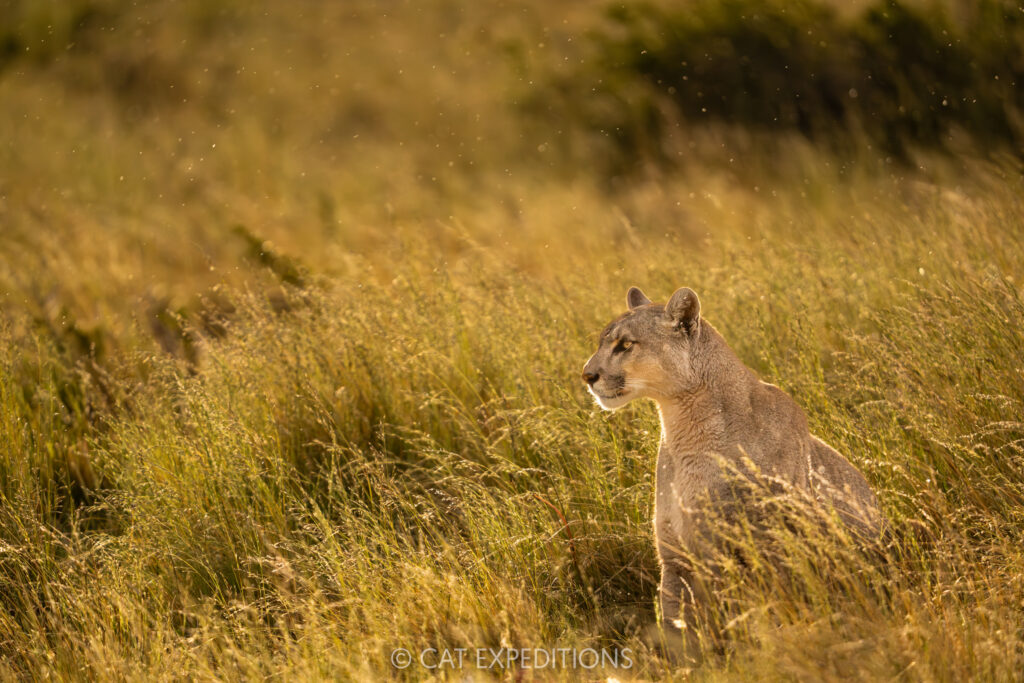
Then the weather added another layer to the scene. Rain began falling while the sun remained behind her, creating beautiful backlight and rim light around the puma and the grasses. The wind made photography difficult, shaking both cameras and vegetation, but every now and then everything lined up perfectly and we were able to capture some especially dramatic images.
Petaca fed for only about 15 to 20 minutes before moving away to another thicket to rest again. We stayed as long as we possibly could, finally leaving the area around 9:00 p.m. and hiking back to the vehicles.
From there, we drove to a scenic overlook above Lago Sarmiento for a picnic dinner. Even after 10:00 p.m., when we finally returned to the lodge, there was still light lingering over the Patagonian landscape—a fitting end to an exceptionally long and rewarding first full day.
Day 3: We were back in the vehicles by 4:30 a.m. and headed straight for the puma area, hoping to relocate Petaka. After parking, we hiked back over the ridge in the predawn darkness to where she had been found resting near the top of the slope in thick vegetation.
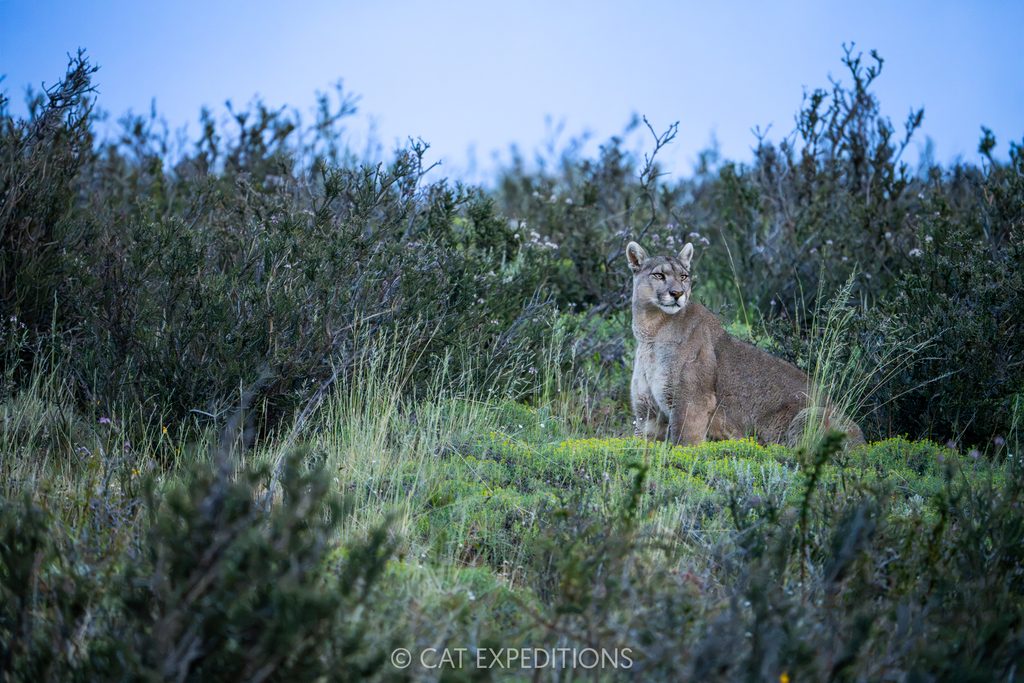
The sighting was beautiful despite the low light. Petaca was sitting quietly, scanning the country below her while repeatedly turning her attention behind. One of the spotters had picked up another puma before we arrived, which made us wonder whether she had been forced to share her kill during the night.
As it turned out, Petaka had done even better than we realized. On the far side of the ridge was a second baby guanaco kill. Eventually she stood, crossed toward that side, and settled into the long grass closer to her second meal.
From there, the morning became an exercise in patience. Between roughly 5:30 and 8:40 a.m., we waited for her to become active again. She rolled over, groomed, slept, lifted her head occasionally, and then disappeared flat into the grass once more. Two female guanacos lingered nearby watching the area, and we wondered if they were the mothers of the two calves Petaca had killed.
By then the morning had turned brilliantly sunny, with less wind than the previous day, though strong gusts still made photography challenging. Eventually we hiked back out and returned to the lodge by about 9:45 a.m.
After lunch and a few hours of rest, we headed back out at 5:00 p.m. The weather had changed considerably. It was much colder now, and the wind had intensified dramatically.
We returned to Petaca’s location and hiked in once again. She was still resting under a thicket near one of the kills. At first we ended up a little closer than we wanted, within roughly 20 meters, so after getting a few quick photographs we backed away and settled into a better position about 60 meters out, with our backs to the wind.
For the next three hours, Petaka did very little. She slept deep in the grass, occasionally lifting her head before flattening back down again. A few times she shifted position and briefly moved into the sunlight, but mostly she remained hidden.
The wind, meanwhile, became the dominant feature of the afternoon. The gusts were fierce enough to throw off cameras and make standing difficult, and by late evening everyone was getting seriously cold.
Finally, around 8:30 p.m., Petaka got up and moved toward the kill to feed. Unfortunately, she was mostly buried in very tall grass, so getting clean photographs was difficult, but after waiting so long it was still rewarding to see her active again. We stayed until about 9:10 p.m. before we absolutely had to begin hiking back to the vehicles.
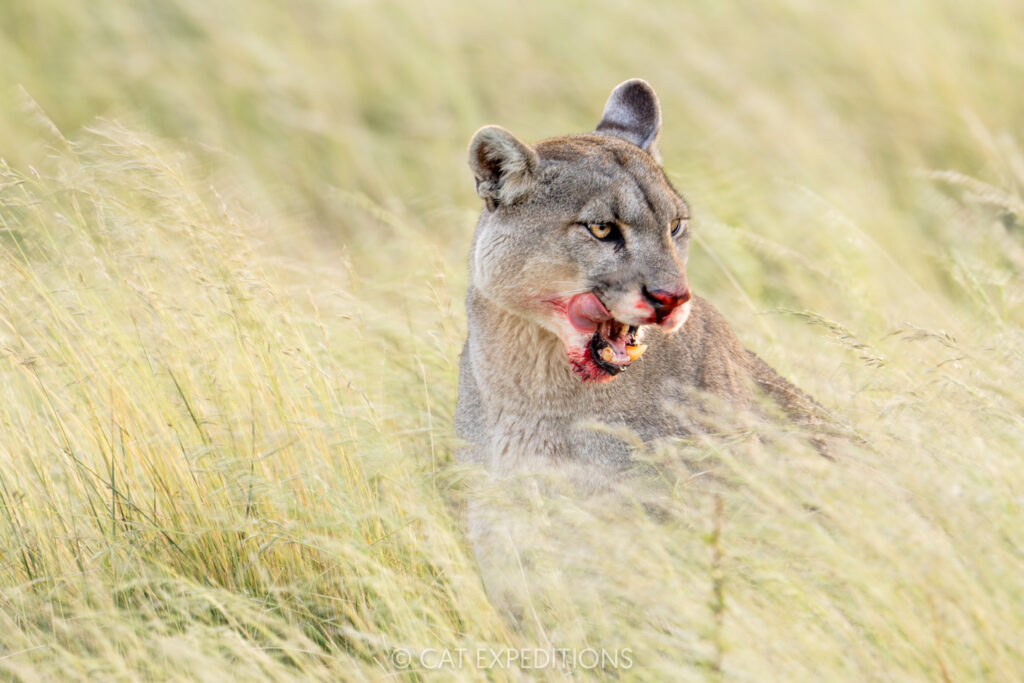
By then everyone was thoroughly chilled, and we were running a little late leaving the property. We drove directly back to the lodge, arriving around 10:00 p.m., where we quickly ate our picnic dinner in the dining room before heading to our rooms.
Thankfully, the radiators had been turned on. After a long, windy evening on the steppe, the warmth felt especially welcome.
Day 4: The weather had turned noticeably colder and grayer overnight, and by the time we left the lodge at 4:30 a.m., Patagonia was showing us a much moodier side. We headed back towards the pumas, this time focusing on the southern side of the property near Lago Sarmiento.
We spent the early hours driving from one high point to another, stopping to scan the hillsides, valleys, and lake edges with binoculars. The views were still spectacular, even under heavy cloud, with Lago Sarmiento and a series of smaller lakes stretching below us beneath a dark, windy sky.
Wildlife was noticeably scarce. There were very few guanacos, which naturally meant fewer opportunities for pumas as well. The quiet morning prompted a lot of discussion about the apparent lack of kittens that year. Only one female with a cub had been seen regularly, and several cats that had been well known in previous seasons had either failed to reproduce or disappeared entirely.
One of those missing cats was Blinka, who had not been seen at all in 2025. Petaka had raised two sub-adults the previous year, but there was no sign of either of them now. Our local guide explained that if Petaka’s daughter were still nearby, there was a good chance she would have joined her at the guanaco kills we had been watching, since pumas in this part of Patagonia are often surprisingly tolerant of other cats around food.
That discussion became even more intriguing when one of our drivers took us to a site he had found roughly two months earlier. There, near a small drying waterhole above Lago Sarmiento, he had discovered Petaka feeding on the carcass of a puma.
We hiked in to see what remained. The body was now mostly reduced to bones, but the long tail, paws, and parts of the head were still visible. It appeared to have been a young cat, and the circumstances were unclear. Had it been ambushed at the waterhole? Was it killed by another puma? Could it even have been one of Petaka’s own offspring? Panthera researchers had already collected samples, but for now the story remained a mystery.
Afterward, we continued scanning from several more vantage points and eventually dropped down toward the lakeshore to collect our spotter, who had been tracking on foot. Nearby, we found nesting coots in a small pond and spent some time photographing them.
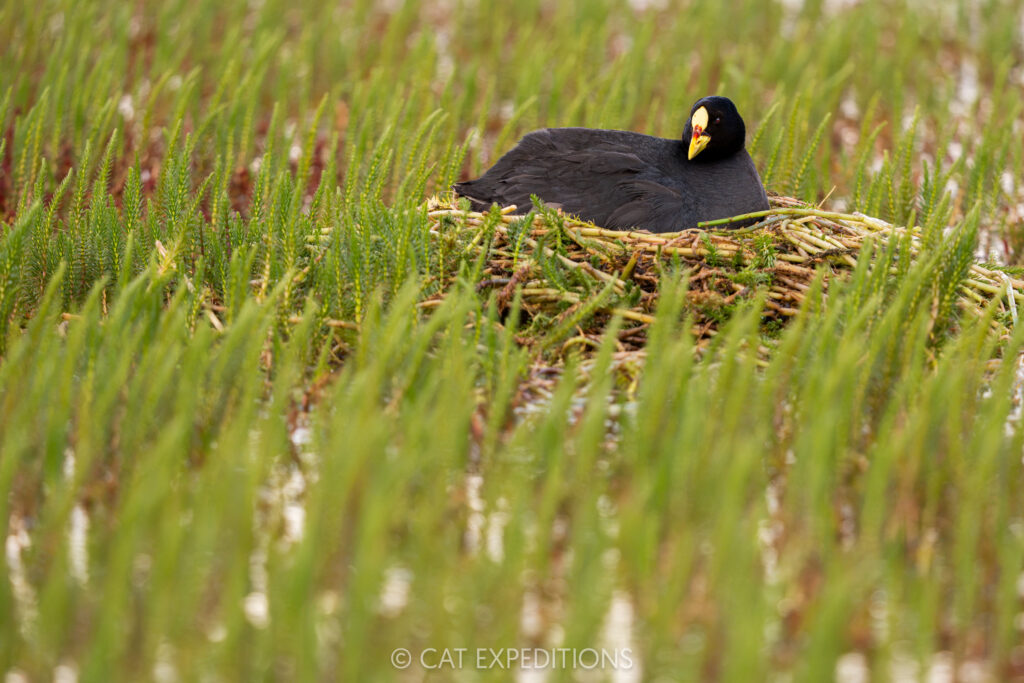
Cats remained elusive, but the morning was still rewarding in a different way: dramatic weather, vast landscapes, and a deeper look at the unknowns that still surround puma ecology in Patagonia. We were back at the lodge by 9:20 a.m. for breakfast.
After lunch, we spent some time working on photographs, in the living room, before heading back out again at 6:00 p.m.
That evening we returned to the same Sarmiento-side country and repeated the search from one high point after another. The landscape was nearly empty. Guanacos were scarce, there were no other vehicles around, and despite scanning every promising slope and basin, we could not find a single puma.
The weather, though, was extraordinary. Strong winds swept across the steppe beneath enormous, fast-changing cloud formations, creating some of the most dramatic vistas of the trip. It was one of those evenings where the scenery almost compensated for the lack of wildlife.
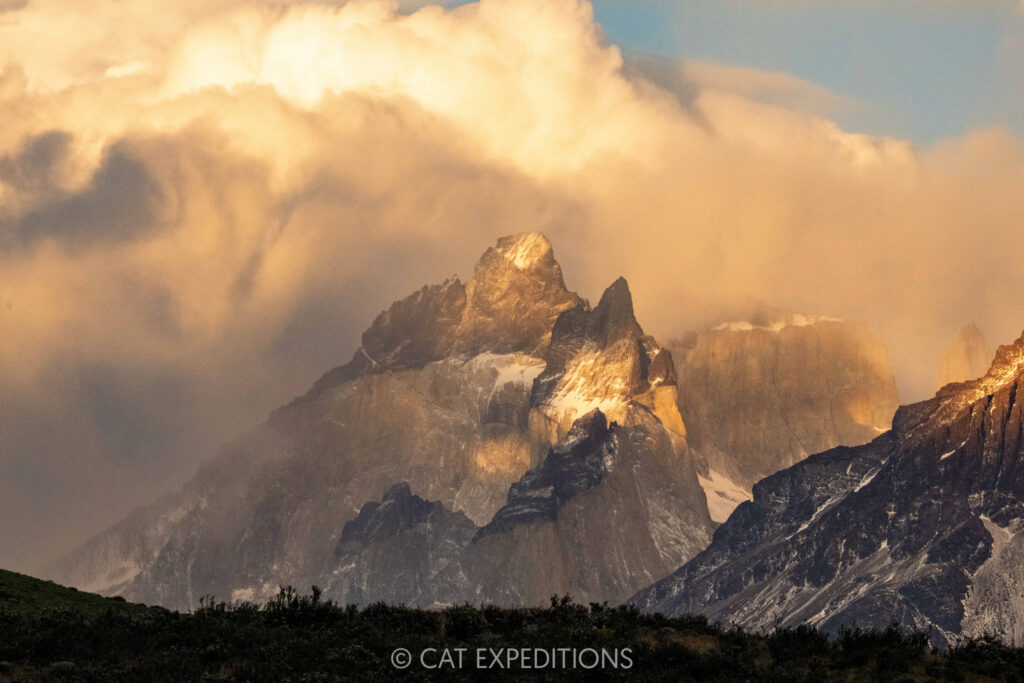
Eventually, with darkness approaching and no cats found, we left the property around 9:40 p.m. On the drive back, the other vehicle suffered a flat tire near Cerro Guido, so everyone squeezed into ours for a very crowded final stretch to the lodge.
We arrived around 10:25 p.m. and headed straight into the dining room for another late picnic dinner, ending a quiet but memorable day in a very wild corner of Patagonia.
Day 5: We were back out by 4:30 a.m. under cool, drizzly, and breezy conditions, heading into a different section of Estancia Amarga. The morning was spent driving from one promising area to another, stopping frequently to scan the hillsides and check rocky outcrops and caves for pumas.
Once again, the landscape seemed unusually quiet. Guanacos were scarce, the wind was fierce, and despite covering plenty of ground, we couldn’t find a cat. The scenery was beautiful as always, but with heavier rain and wind expected later in the morning, we decided to return to the lodge a little early and save our energy for the afternoon.
Just before reaching the lodge, however, we spotted the other group stopped beside the road. They had found an armadillo.
We climbed out on foot to photograph it, but the little animal was understandably nervous and quickly disappeared into a burrow. We all stayed completely still and quiet. Before long, its head cautiously appeared again, peeking out to see whether the coast was clear. It repeated this a few times before finally deciding we were harmless enough and emerging completely.
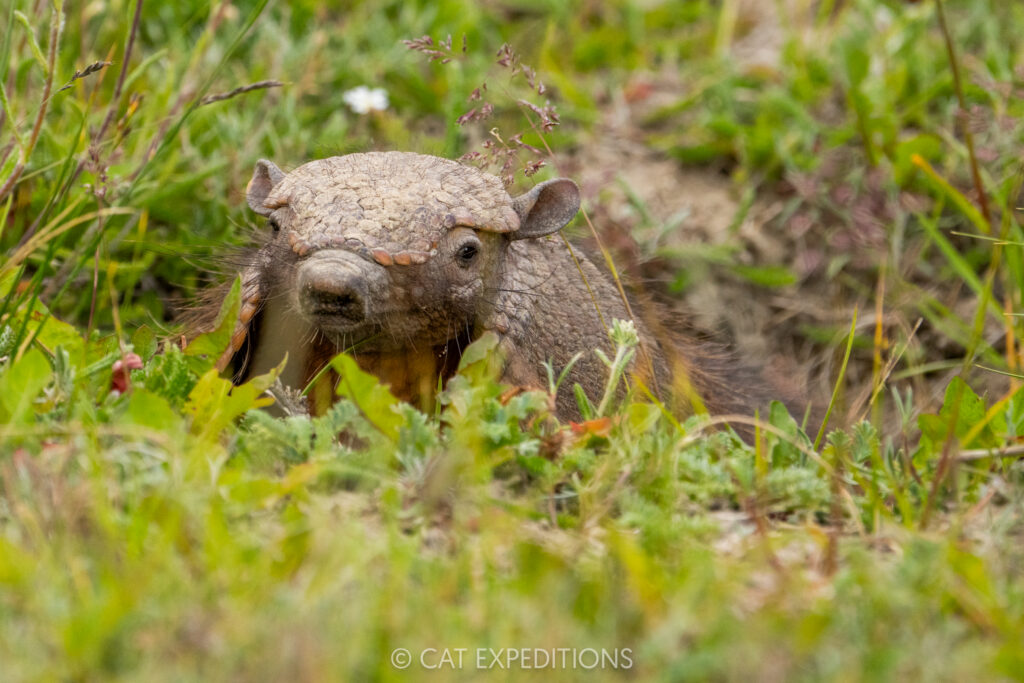
Once out, it began moving around normally again and gave us some wonderful photographic opportunities. Not quite the puma encounter we had set out for, but unquestionably one of the cutest sightings of the trip.
We were back at the lodge by 8:45 a.m.
By afternoon, the weather had deteriorated further. Rain swept across the landscape and the wind was howling, but by 5:40 p.m. we were bundled up and back in the vehicles, prepared for whatever Patagonia wanted to throw at us.
For the first couple of hours, we repeated the familiar routine: drive, stop, scan, scope, and keep searching. Eventually word came that a cat had been seen somewhere in the area. But before we could make a decision, our local guide picked up a puma himself with the thermal scope, far across the landscape on the opposite side of a ridge. She was tucked into the black bush, watching us from an enormous distance.
We geared up for a hike in the wind and rain and started toward her. Then the puma lifted her head above the vegetation and we recognized her.
It was Dania.
Dania was one of Rupestre’s cubs that we had seen back in 2020, making the sighting immediately more special. She had grown into a wonderfully relaxed adult and was known as a particularly good cat to follow on foot.
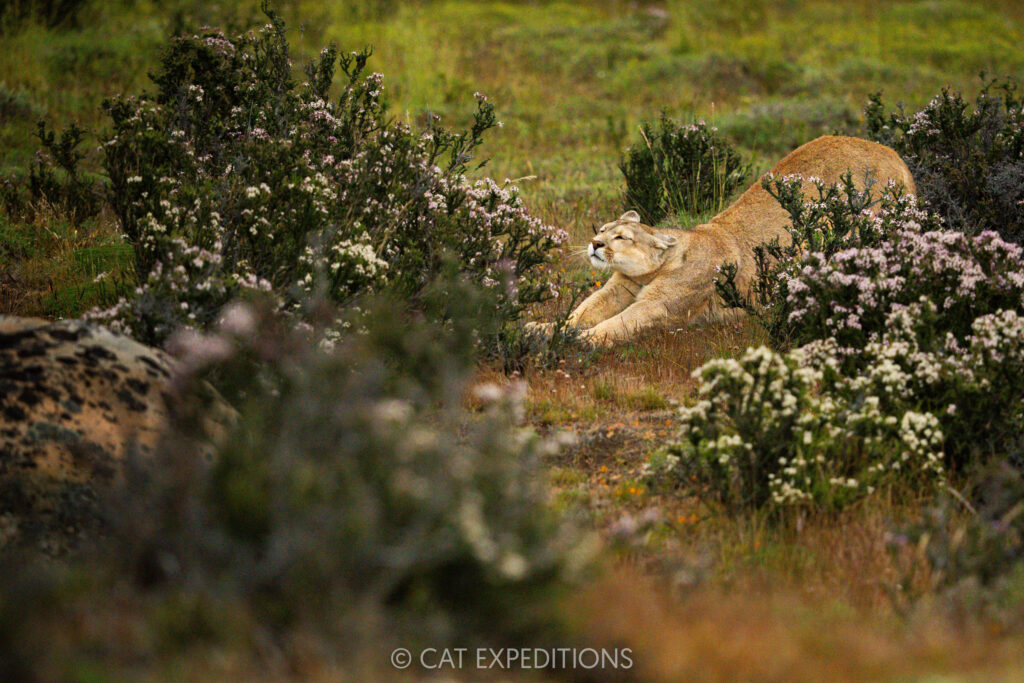
Almost as soon as we approached, she began moving. For the next two hours we worked our way across the landscape with her, repeatedly hiking ahead, finding a position, photographing her as she approached, and then moving again. She led us up and over a ridge overlooking Laguna Amarga before gradually descending toward the lake.
Dania seemed perfectly comfortable with our presence as long as we respected her space. She would glance at us briefly, assess the situation, and simply continue on.
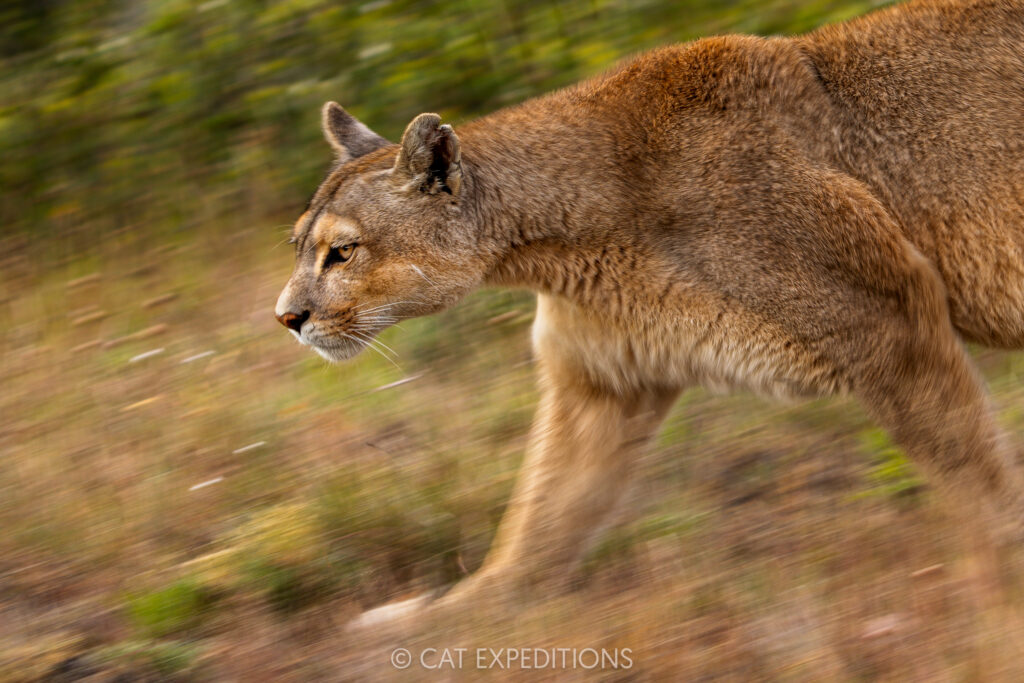
The terrain became muddier and more slippery as we descended through the scrub, carrying cameras, packs, and other gear, but the guides were fantastic, helping everyone along the way and making sure we could safely position ourselves whenever Dania paused.
From roughly 7:45 until 9:45 p.m., we stayed with her as she moved steadily toward the lower elevations. Rain came and went, the wind continued to blow, and the light grew increasingly dim, but the photographic opportunities were fantastic. Dania paused among wildflowers and lush green vegetation, scent-marked several times, and occasionally lifted her lip in a flehmen response as she investigated scents left by other cats.
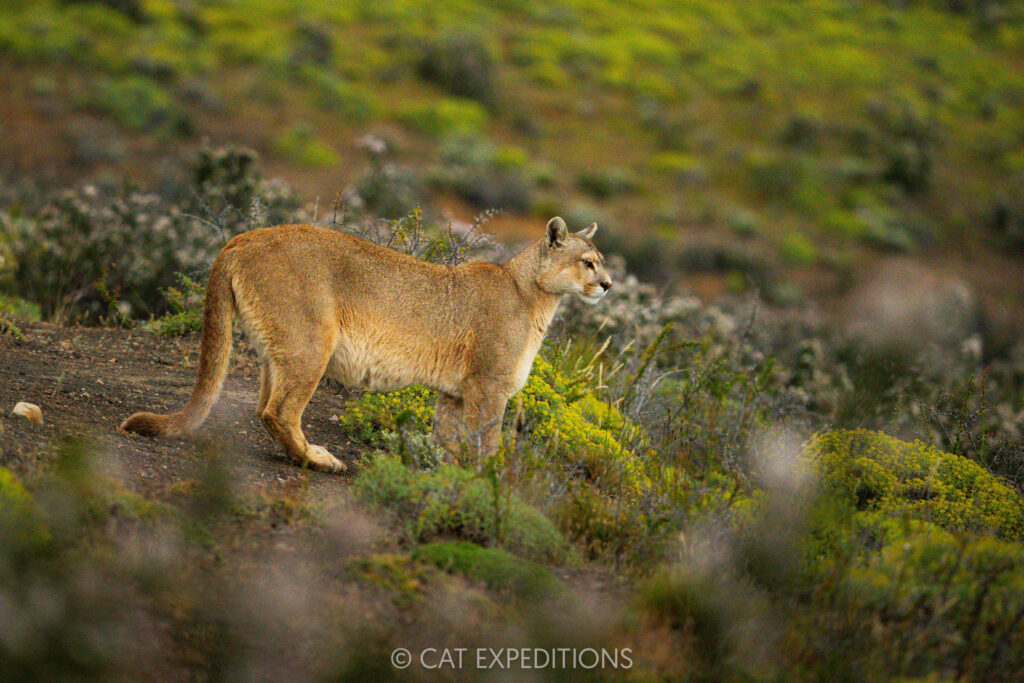
Eventually we reached the main road near the lake. Guanacos began alarm calling at her presence, and Dania crossed the road several times before continuing alongside it. Another vehicle of visitors had arrived by then, and their excitement at seeing a wild puma at such close range was contagious.
Because we had followed Dania all the way down to the road, the guides hiked back uphill to retrieve the vehicles while we remained below. As darkness settled over the landscape, we were able to watch her continue walking along the roadside, and even capture some final video as she disappeared into the evening.
We finally left the estancia around 10:00 p.m. and made it back to the lodge for a very late dinner.
After such a quiet morning, the day had completely transformed. Two hours on foot with Dania, watching her move naturally through wildflowers, scrub, rain, and wind, became one of the most immersive puma encounters of the trip.
Day 6: Our final full day began colder, wetter, and wilder than any morning so far. We left the lodge at 5:05 a.m. hoping to relocate Petaca at her kill, but overnight the weather had completely transformed the landscape. Rain, wind, and even snow had swept through, coating the surrounding mountains in fresh white all the way down to roughly 600 meters.
Almost immediately, we spotted a Molina’s hog-nosed skunk crossing a bridge near the lodge. From there we continued toward Petaca’s last known location, but when we arrived she was gone—and, so was the carcass.
That kicked off another long search. Everyone spread out to scan and scope while we worked our way through the estancia. The weather was intense enough that every available layer came out: jackets, warm gear, gloves, anything we had. Fresh snow covered the mountains on every side, creating a spectacular backdrop even if the pumas remained hidden.
We kept scanning and driving until around 8:45 a.m. before finally calling it and returning to the lodge for breakfast.
The search continued across the northern section of the estancia. We checked ridge after ridge, stopping at every high point to scan the valleys below. A few more guanacos were around, along with several chulengos (baby guanaco), and we found an old chulengo kill tucked beneath a thicket, partly covered by vegetation. But for hours, no pumas appeared.
By 9:00 p.m., we were just about ready to stop and photograph another hog-nosed skunk when the radio came alive: Our puma tracker had found a female puma and cub on a kill.
We jumped back into the vehicle and drove quickly toward a ridge near the lagoon. After gearing up, we hiked a short but steep slope onto an open plateau—and there they were.
The first cat we saw was the cub, around seven or eight months old. Then his mother came into view beside the carcass.
It was Nieve and her son, Copito.
Nieve was strikingly pale, with especially beautiful eyes, and she was wearing a research collar. Copito spent some time feeding and playing with the carcass while his mother rested nearby, partly hidden behind a thicket. Every now and then he paused in the open, giving us lovely views.
Then he wandered away from the kill and gave us a fascinating bit of behavior. He dug into the dirt, defecated, and then vigorously scratched soil back over the scat. Young pumas seem to cover their droppings more frequently than adults, and it was interesting to watch the behavior unfold at close range.
After a while, Nieve moved over to feed, tugging at the carcass and trying to reposition it while Copito watched from a short distance away. The wind was still blowing hard and the last light was disappearing rapidly, pushing our cameras to very high ISOs, but the cats remained wonderfully relaxed with us.
Then Copito decided feeding wasn’t enough entertainment.
He crept toward his mother and began stalking her. Nieve noticed, stopped feeding, and within seconds the quiet scene turned into a game of chase and pounce. The two bounded after each other through the vegetation, Copito repeatedly launching playful attacks while Nieve responded in kind. The fading light and thick vegetation made photography difficult, but the action was too good not to try, and we managed to capture at least a few frames of the interaction.
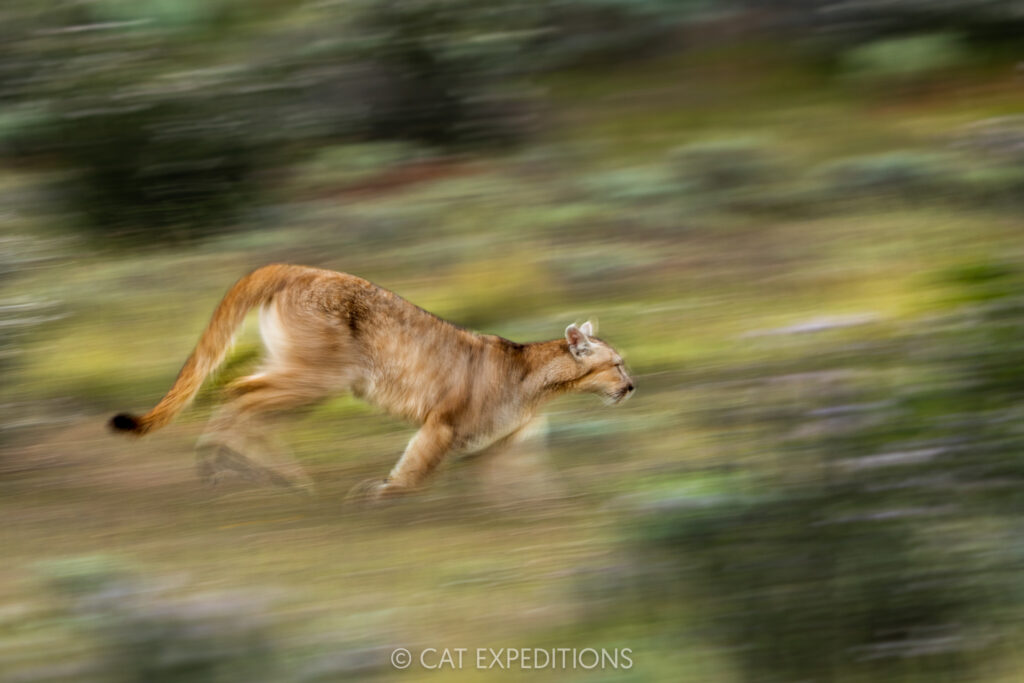
To finish our last full day with a relaxed mother and cub, feeding, playing, and interacting naturally against the wild Patagonian landscape felt like an extraordinary reward.
Eventually, we left Nieve and Copito and hiked back to the vehicles. We departed the estancia around 10:15 p.m. and raced back to the lodge for a hot dinner.
That final meal became a fitting end to the trip, filled with stories, laughter, toasts, and thanks to the guides and staff who had made the week so memorable. By 11:30 p.m. we were finally back in our rooms.
It was difficult to leave. Between the pumas, the landscapes, the wild weather, and the warmth of everyone at Cerro Guido, Patagonia had once again been unforgettable.
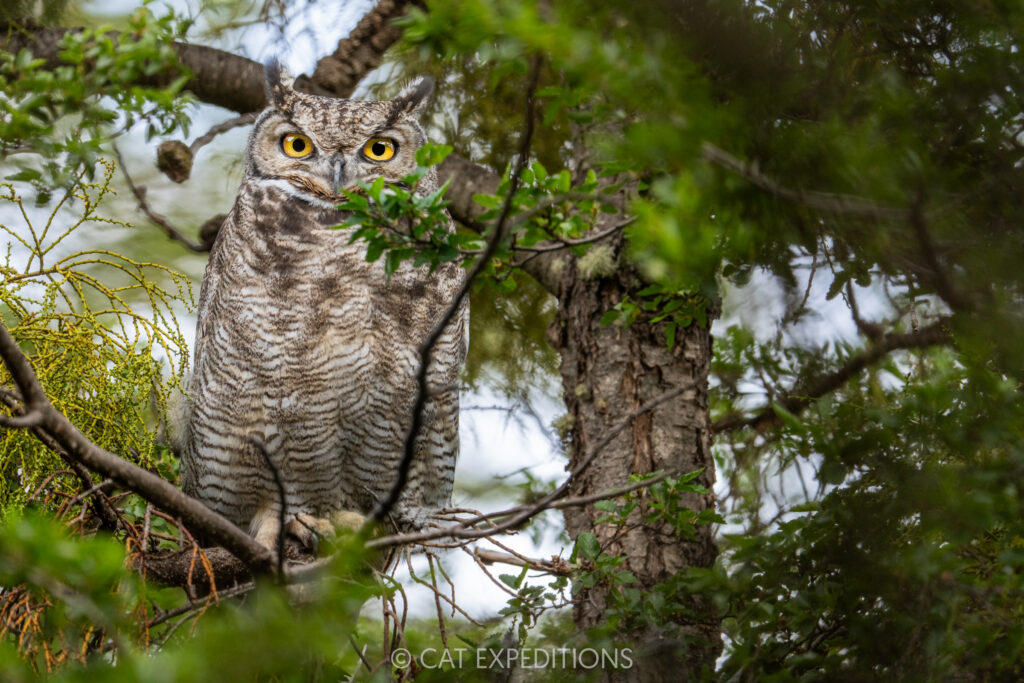
Day 7: Some of our guests left early to catch their onward flights from Puerto Natales but most of us had time to bird within Torres del Paine National Park. We really tried for Magellanic woodpecker, were unsuccessful, but were treated to a Lesser Great-horned Owl. It was a fantastic way to finish the trip!
Species List for our Pumas of Patagonia Photo Tours in 2025
Mammals
| Puma | Puma concolor |
| South American Gray Fox | Lycalopex griseus |
| Guanaco | Lama guanicoe |
| European Hare | Lepus europaeus – Introduced |
| Pygmy Armadillo | Zaedyus pichiy |
Birds
| Lesser Rhea | Rhea pennata |
| Black-necked Swan | Cygnus melancoryphus |
| Coscoroba Swan | Coscoroba coscoroba |
| Upland Goose | Chloephaga picta |
| Flying Steamer-Duck | Tachyeres patachonicus |
| Crested Duck | Lophonetta specularioides |
| Chiloe Wigeon | Mareca sibilatrix |
| Yellow-billed Teal | Anas flavirostris |
| Plumbeous Rail | Pardirallus sanguinolentus |
| Red-gartered Coot | Fulica armillata |
| Southern Lapwing | Vanellus chilensis |
| Brown-hooded Gull | Chroicocephalus maculipennis |
| South American Tern | Sterna hirundinacea |
| Great Grebe | Podiceps major |
| Silvery Grebe | Podiceps occipitalis |
| Andean Condor | Vultur gryphus |
| Cinerous Harrier | Circus cinereus |
| Black-chested Buzzard-Eagle | Geranoaetus melanoleucus |
| Lesser Horned Owl | Bubo magellanicus |
| Striped Woodpecker | Veniliornis lignarius |
| Chilean Flicker | Colaptes pitius |
| Southern Caracara | Caracara plancus |
| Chimango Caracara | Daptrius chimango |
| American Kestrel | Falco sparverius |
| Wren-like Rushbird | Phleocryptes melanops |
| Thorn-tailed Rayadito | Aphrastura spinicauda |
| Rufous-tailed Plantcutter | Phytotoma rara |
| White-crested Elaenia | Elaenia albiceps |
| Austral Negrito | Lessonia rufa |
| Spectacled Tyrant | Hymenops perspicillatus |
| Fire-eyed Diucon | Pyrope pyrope |
| Chilean Swallow | Tachycineta leucopyga |
| Southern House Wren | Troglodytes musculus |
| Grass Wren | Cistothorus platensis |
| Austral Thrush | Turdus falcklandii |
| House Sparrow | Passer domesticus |
| Black-chinned Siskin | Spinus barbatus |
| Rufous-collared Sparrow | Zonotrichia capensis |
| Long-tailed Meadowlark | Leistes loyca |
| Austral Blackbird | Curaeus curaeus |
| Yellow-winged Blackbird | Agelasticus thilius |
| Gray-hooded Sierra Finch | Phrygilus gayi |