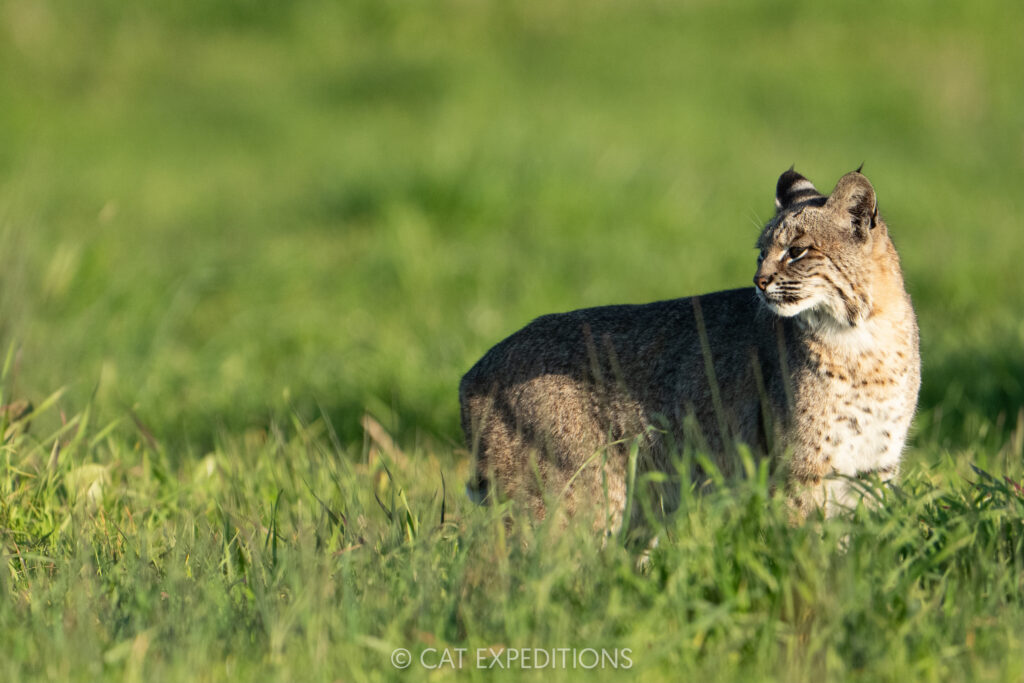
In 2025, we led two different Bobcats of California photo tours in early December, a private trip, and our usual bobcat tour. Our trip started a bit slower with cats, which happens sometimes, but by the end of the trip we had spent many hours following and photographing bobcats, including watching one of the most intriguing bobcat behaviors yet!. Read our Bobcats of California Photo Tour 2025 Trip Report to get all the details.
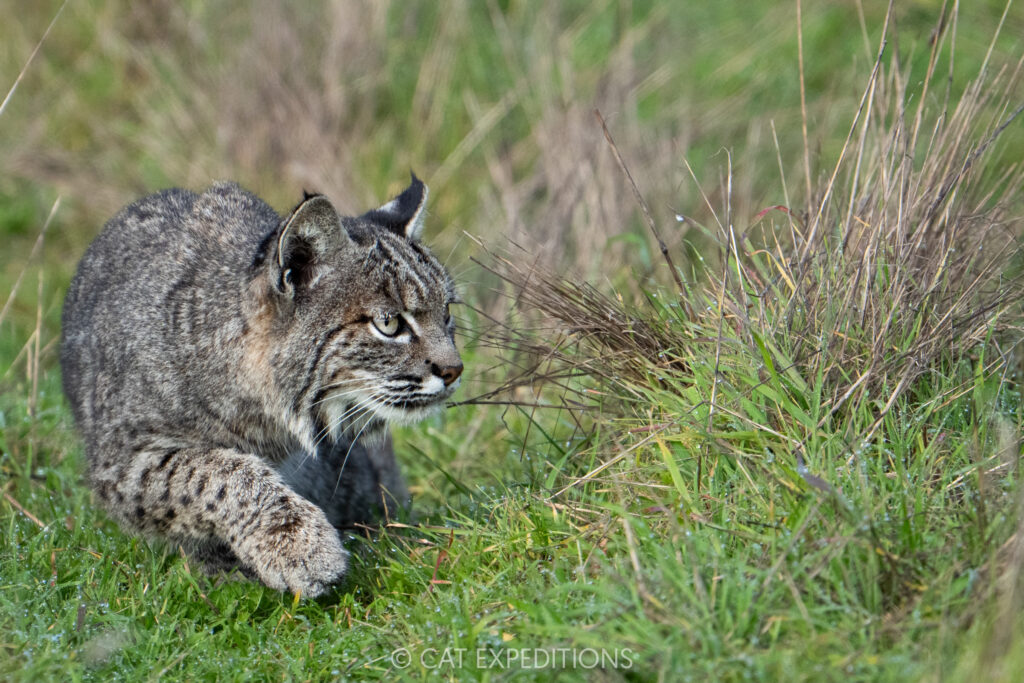
Highlights of the 2025 Bobcat Photo Tour
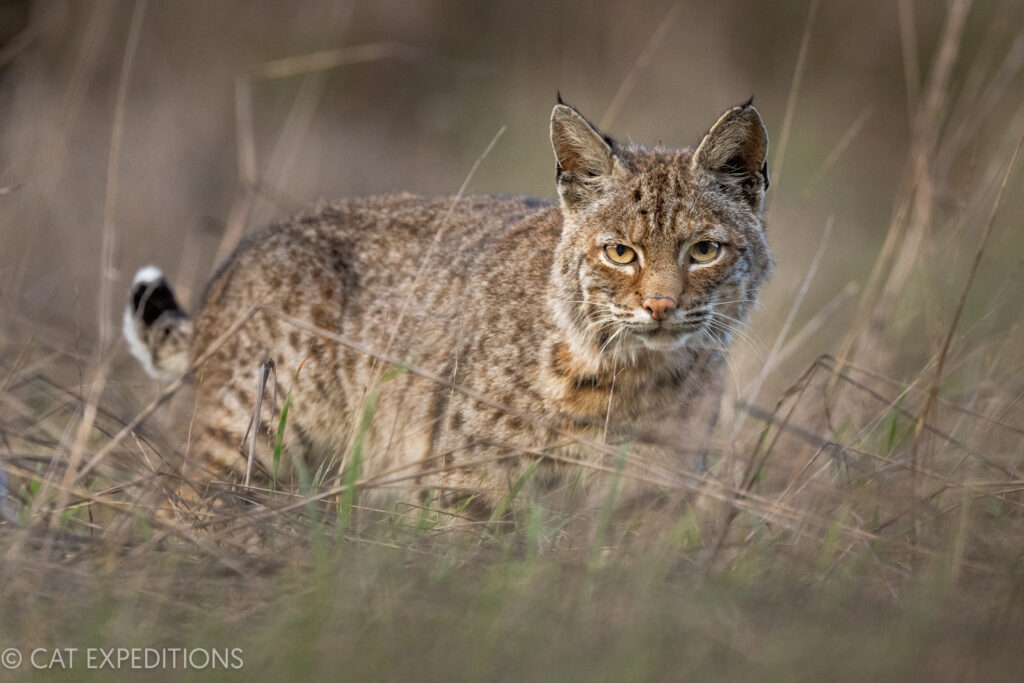
Bobcats: For the duration of the trip, we had at a minimum five bobcat sightings, and at a maximum fifteen (a new tour record). Sightings averaged twelve minutes, at an average distance of 25 meters. For our closest encounter the bobcat was two meters away!
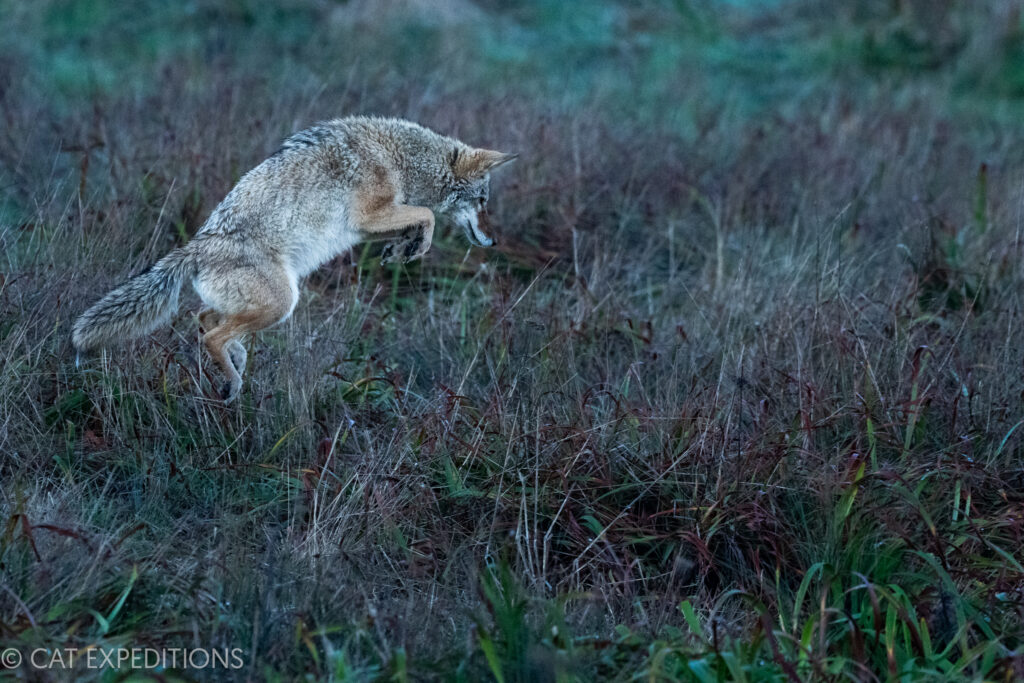
Coyotes: As usual, there were too many coyotes to count. During each tour we were able to watch them hunt!
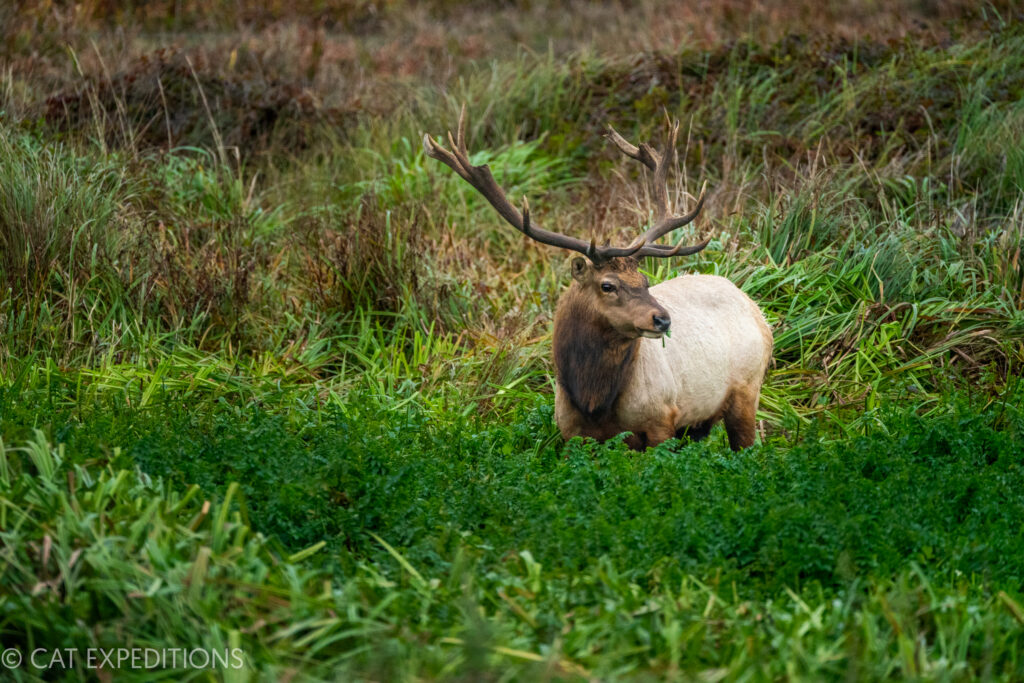
Tule Elk: Tule elk are a subspecies of elk, endemic to California. Though not hard to find, we always enjoy them! We had a nice moment with an elk browsing in a pond.
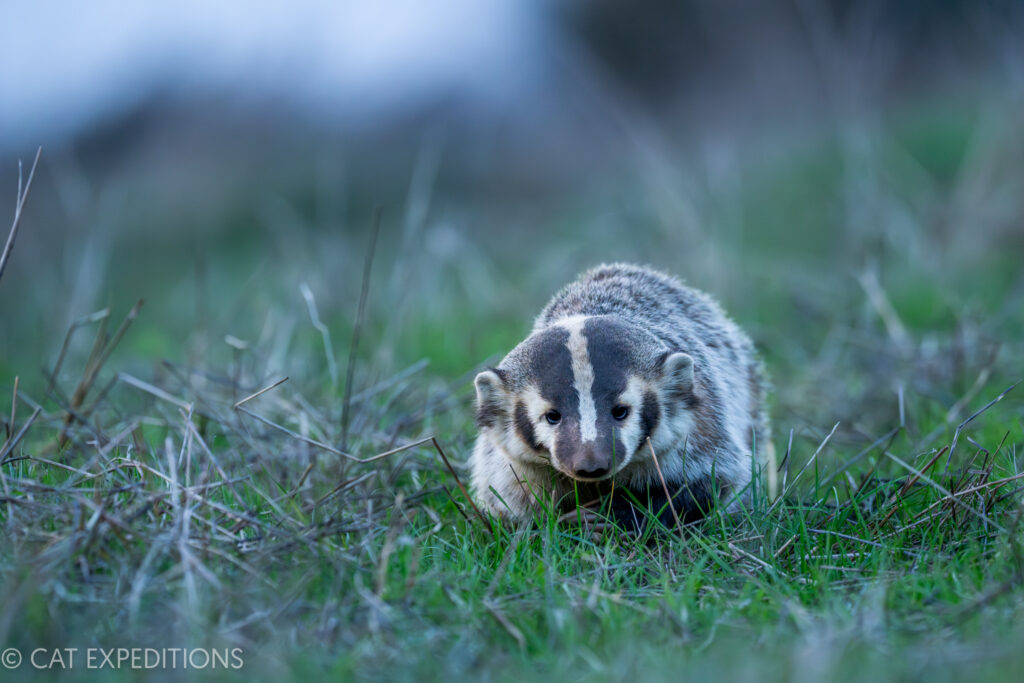
American Badger: In a tour first, for one of our trips, we had an incredible, extended sighting and encounter with an American Badger.
Detailed Trip Summary of our 2025 Bobcats of California Photo Tour
Day 1: A couple of our guests arrived early, and with a free morning before the tour officially began, we decided to do a little informal birding together. Our new Cat Expeditions guide, Chris Daniels, joined us for the trip and immediately impressed everyone with his incredible knowledge of birds. With his help, we recorded more than 30 species in just that first morning alone. By the end of the trip, our total had climbed to 50 species.
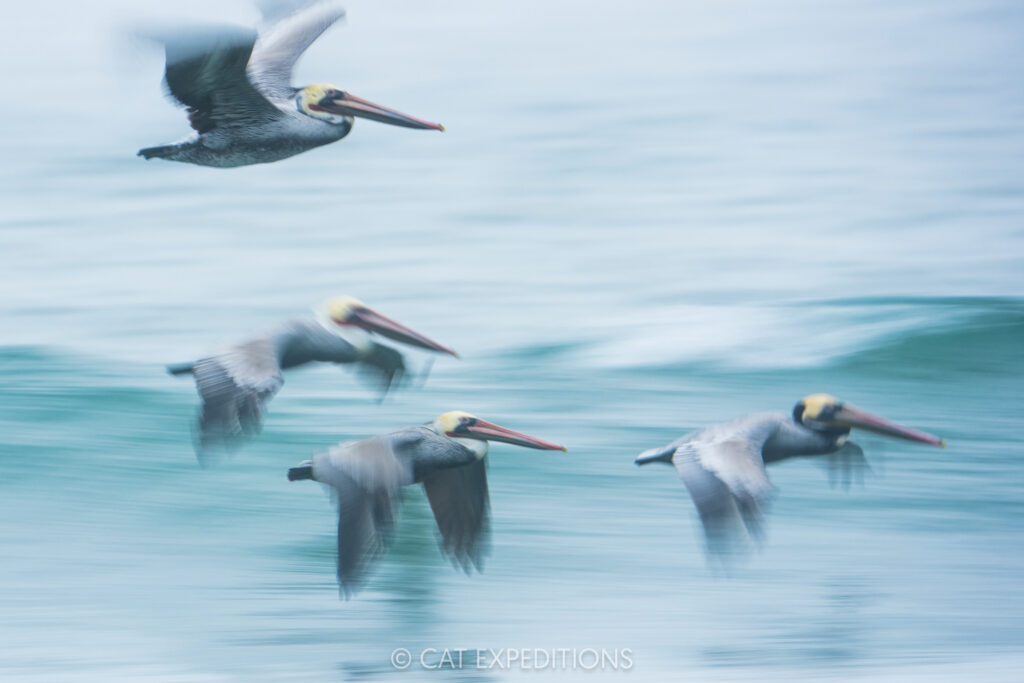
We started with a short walk and were lucky enough to spot a pair of river otters swimming past almost as soon as we reached the the location we hoped to see them in. They only stayed in view for a moment, but it was a wonderful way to start the day. We also had some beautiful photographic opportunities with California Quail, Wilson’s Snipe, Snowy Plovers, goldeneyes both on the water and in flight, and, of course, one of our favorites: Brown Pelicans.
That afternoon, once the rest of the group had arrived, we gathered for an introduction to the bobcats of the region, including what we hoped to see, how we would approach photography, and, most importantly, how to behave around the wildlife. Then we headed out for our first proper search to see what nature was willing to offer us.
We spent the afternoon working through one of our favorite areas. There were definitely bobcats around, but the first couple we found already had one or two photographers with them. In those situations, we always choose to move on rather than add more pressure to the animal or interfere with someone else’s sighting. We would much rather keep searching than crowd a cat. As always on a Cat Expeditions trip, the welfare of the wildlife comes first.
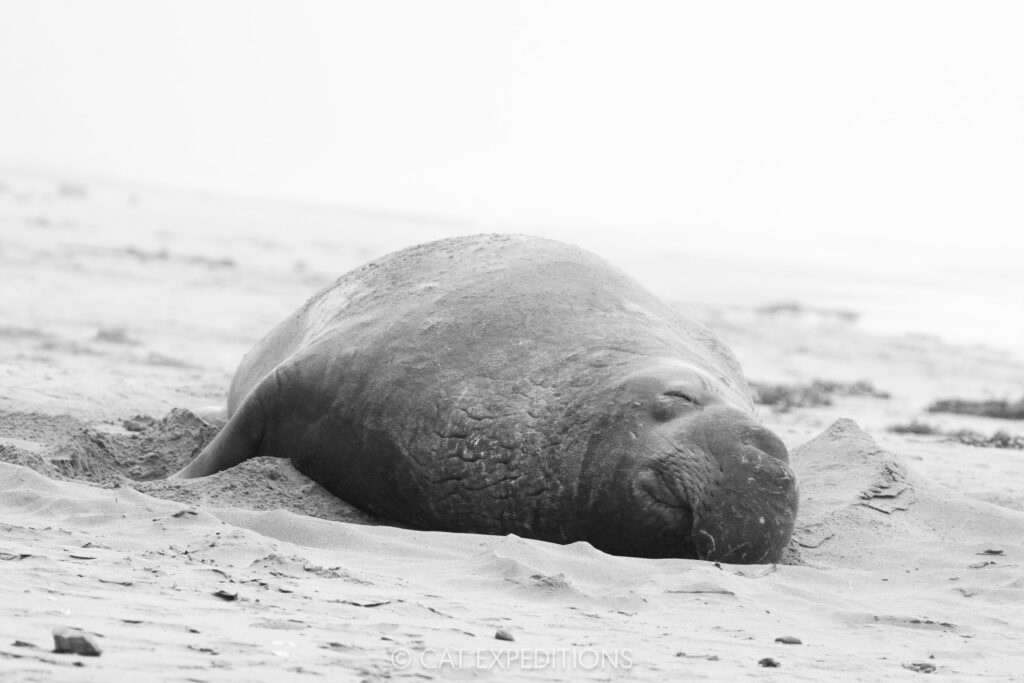
Day 2: The morning began wet and gray, with steady rain making conditions a little more challenging. We spent the first part of the day checking several areas for bobcats, but came up empty. With the cats proving elusive, we shifted our attention to some of the other wildlife and spent time with elephant seals and a variety of shorebirds before returning to our search.
Eventually, our bobcat tracker found a bobcat on a hillside above us. We had good distant views, but when we tried to approach, the terrain made it difficult to move without being noticed, and the cat slipped into the brush. Rather than push it, we backed off.
Not long after, we found a second bobcat, a male we recognized by part of one ear being missing. We tried to follow from higher ground but quickly lost him in the thick vegetation. A third cat was being watched by a couple of other people nearby, but again, we chose to disengage and give it space. With the morning sightings all proving brief, we broke for lunch.
The afternoon turned into something completely different.
Soon after returning, our tracker located another bobcat on a hillside. This time, we were able to follow it carefully on foot as it skirted the edge of the brush, giving us some beautiful views before disappearing into cover.
We decided to wait.
That patience paid off when the bobcat eventually re-emerged and crossed the road in front of us. It then settled near a fence line at the top of a hill, sitting quietly for quite some time and giving us a wonderful opportunity to watch without needing to move closer.
Eventually, the cat moved out into the open field, and from there the sighting became one of the highlights of the trip. For more than an hour and a half, we were able to follow at a respectful distance on foot as the bobcat went about its evening. We watched it scan the landscape, stalk through the grass, hunt, and pounce repeatedly, all while the light shifted through a variety of beautiful conditions.
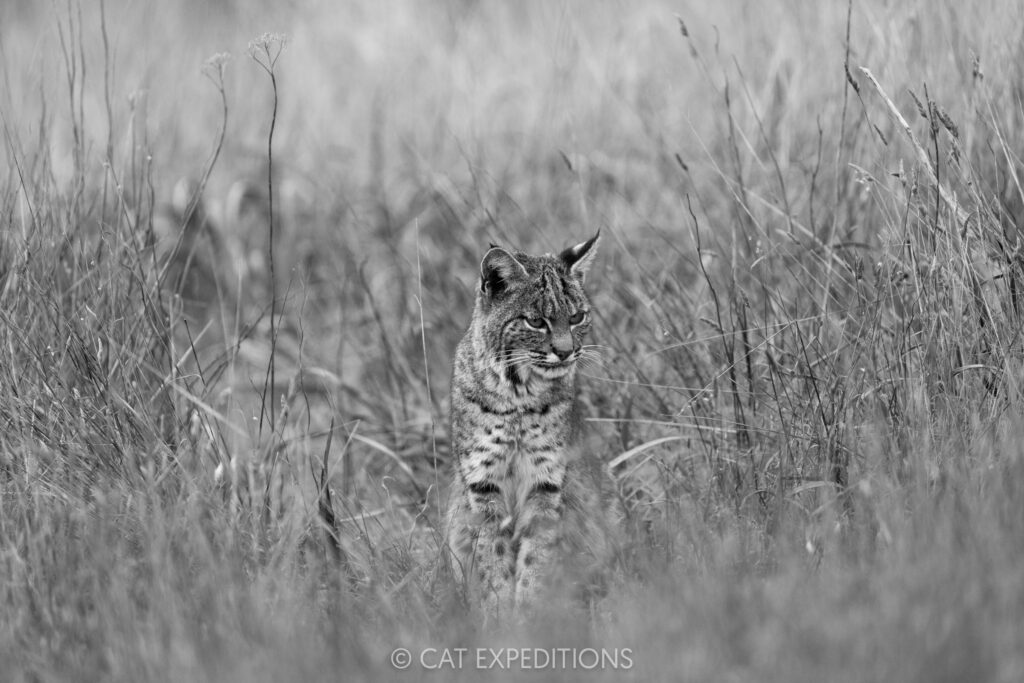
We stayed with the cat until the last usable light disappeared. After a morning of brief glimpses and cats melting quickly into cover, spending an entire afternoon quietly observing one bobcat behaving naturally felt especially rewarding.
Day 3: It was all about bobcats from the very start of the day.
Heavy fog covered parts of the area that morning, so we headed instead toward one of our favorite places where the skies were clear and a beautiful sunrise was beginning to light up the landscape. Tule elk stood along a high ridge, and we quickly hiked up for a better view. The scene was spectacular: elk illuminated by the early sunlight, layers of forested hills behind them, and fingers of fog winding between the trees below.
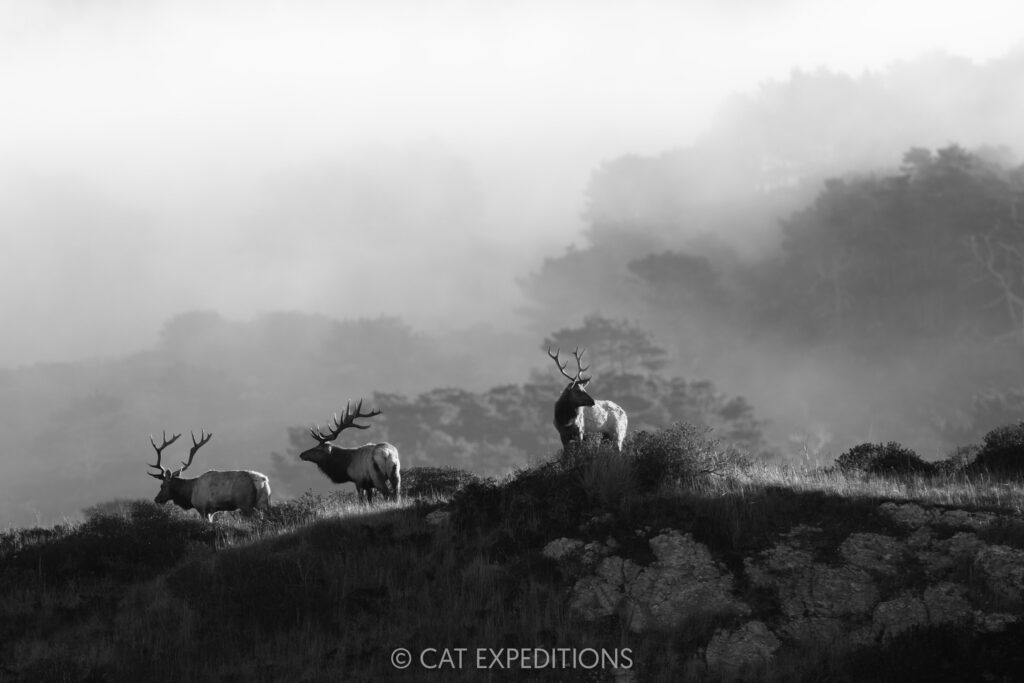
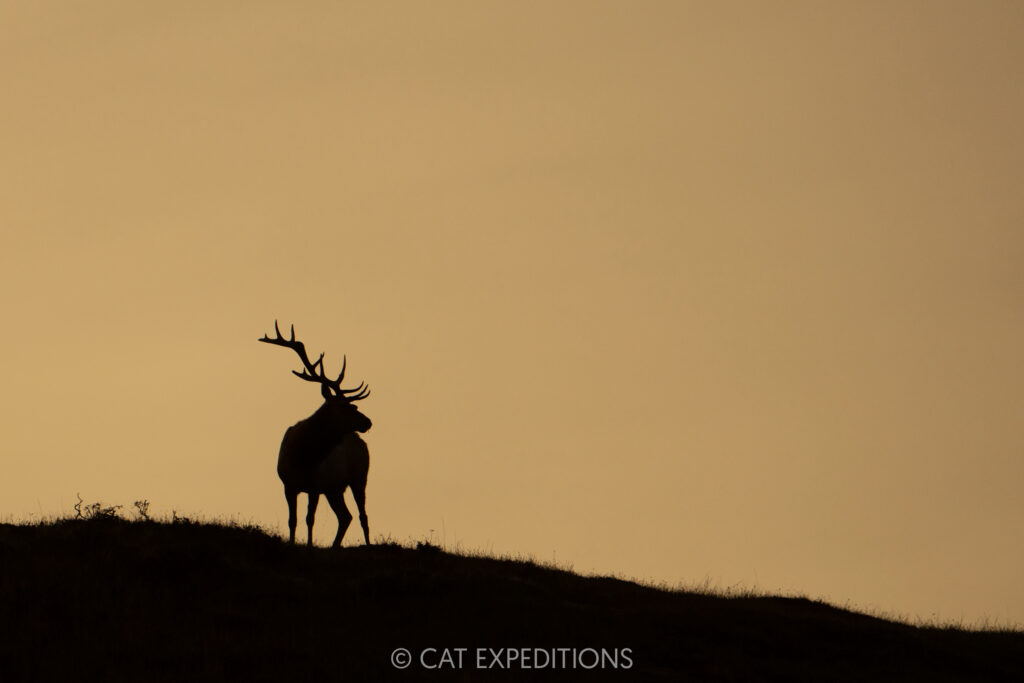
One of our vehicles stayed with the elk for a while longer while also searching the surrounding woodland for additional bird species.
As we began moving on, our spotted found a bobcat from high on a hillside. We had spent time with this particular individual before and knew him to be rather shy, so instead of approaching, we simply waited to see what he would do.
As we watched, we suddenly noticed a coyote very close to him. Apparently neither animal had realized the other was there, because the coyote abruptly bolted in the opposite direction while the bobcat quickly disappeared the other way. They seemed to have startled each other equally, and with both animals moving off, we continued our morning.
The fog was still lingering heavily in other parts of the landscape, so we shifted areas once again. Along the way, we encountered a pair of coyotes walking through a field filled with yellow wildflowers. One continued quickly uphill, but the second lingered and gave us some gorgeous photographic opportunities. Several times it sat surrounded by yellow flowers and fresh green vegetation, its thick brownish-gray coat standing out beautifully against the landscape. We saw several other coyotes that morning, but none in quite such a photogenic setting.
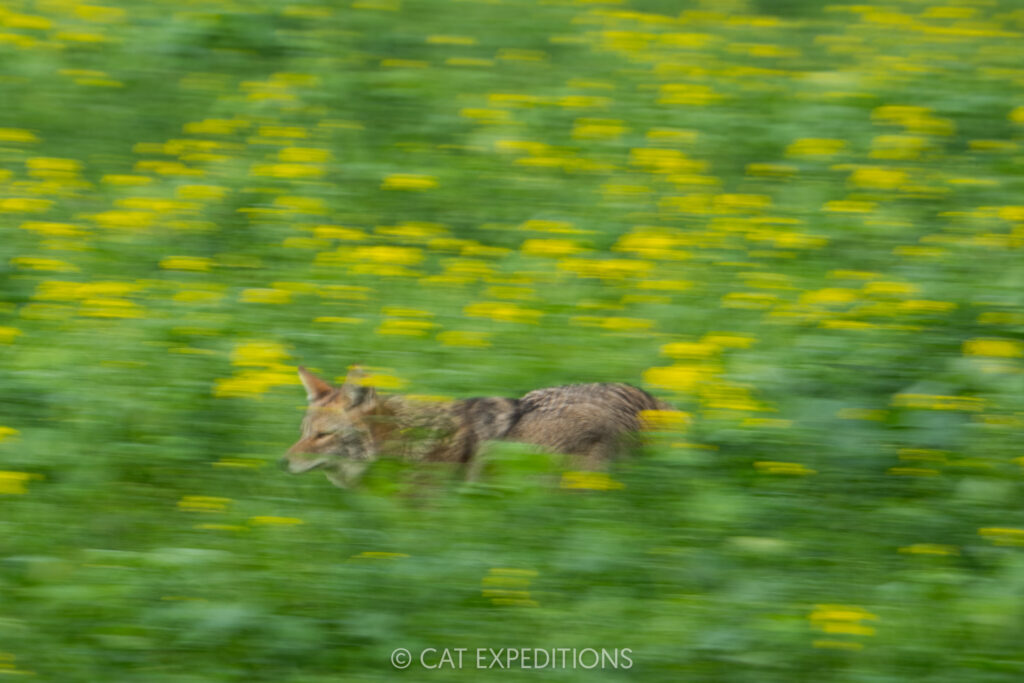
We continued adding to our bird list as well, photographing Western Bluebirds and even finding a Peregrine Falcon perched nearby.
As the morning progressed, we returned our attention fully to bobcats and spread out to search another productive area. We spotted one cat high on a hillside, but it was already moving toward cover when we saw it. Within moments it disappeared below the ridge, likely dropping into the valley beyond. We positioned ourselves on either side and waited to see if it would reappear, but after several minutes with no sign of the cat, we moved on.
Soon afterward, a friend let us know about another bobcat.
One of the things we appreciate most about working in this area is the community of people who deeply care about the cats. Many photographers and wildlife watchers make an effort to respect both the animals and one another’s sightings. Unfortunately, we also regularly see people who are unfamiliar with wildlife behavior pushing or chasing cats in an effort to get closer. For us, it is incredibly important not to crowd an animal, add unnecessary pressure, or interfere with someone else’s encounter. When a sighting is already busy, we would always rather move on and find another cat.
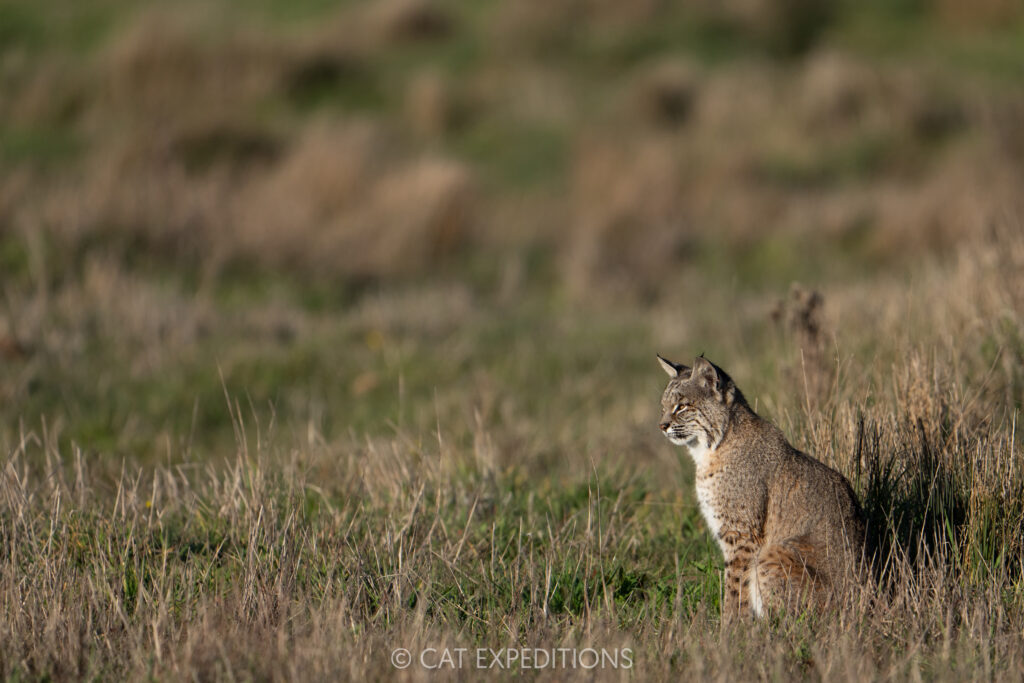
We spent close to an hour with this bobcat before another appeared on the opposite ridgeline. It was another reminder of just how remarkable the density of cats can be here.
The second cat was a female we know especially well and have spent many hours observing over the years. Because of that familiarity, we have a good sense of her normal behavior and the distances at which she remains comfortable. We settled in and watched as she hunted, making several attempts on gophers as she worked her way through the grass.
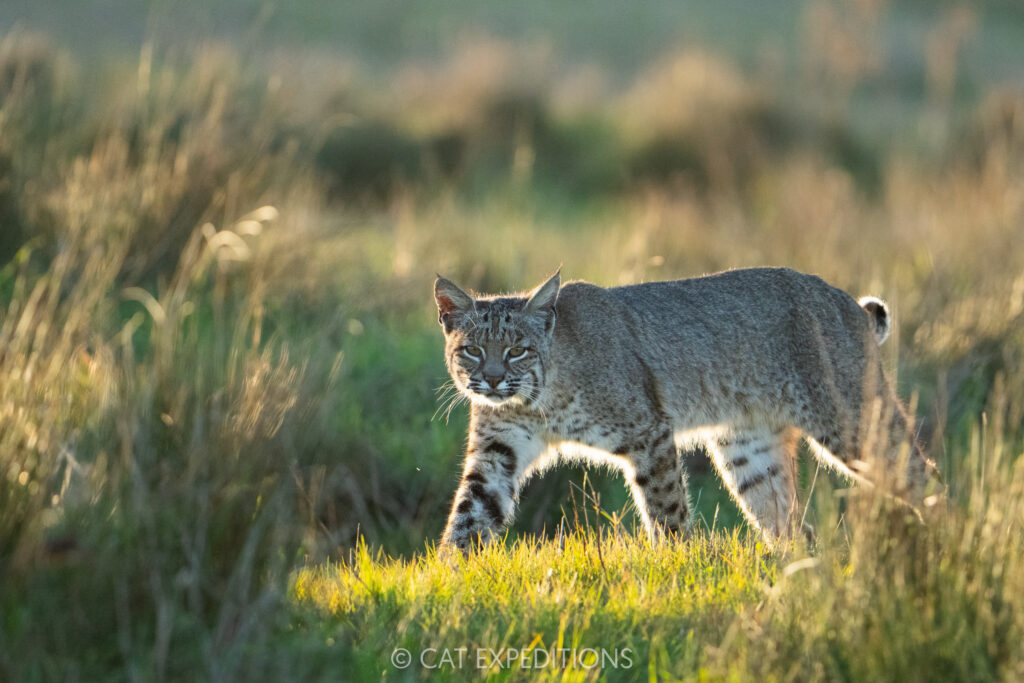
Then we witnessed something we had never seen before.
After one unsuccessful hunting attempt, the female bobcat continued walking and searching for another opportunity. A turkey vulture appeared overhead, circling unusually low nearby. Almost immediately, the bobcat picked up her pace and began jogging directly toward the area beneath the circling bird.
Just beyond her view was another turkey vulture on the ground.
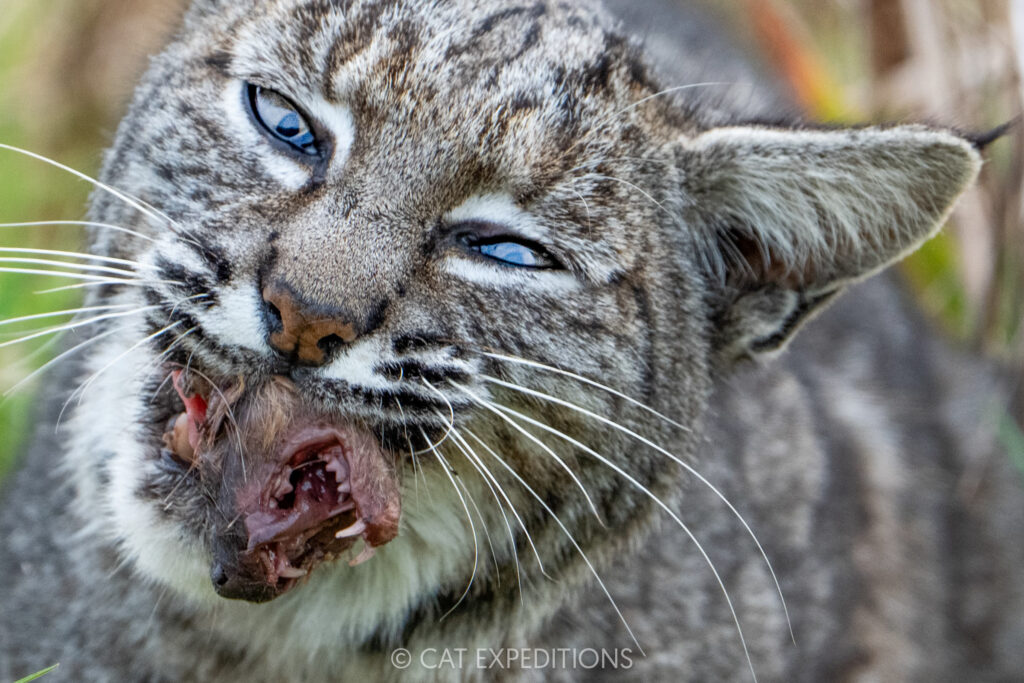
As the bobcat approached, she flushed the vulture and then suddenly pounced on something nearby. We slowly repositioned to see what she had found and discovered that it was a dead weasel.
From everything we could observe, it appeared that the bobcat had used the behavior of the circling turkey vulture as a cue that there might be carrion nearby, then moved in and scavenged the carcass the vultures had located. We had never personally witnessed a bobcat scavenging before, and watching her apparently read the activity of another species to find a potential meal was one of the most fascinating behaviors we have ever seen on a Cat Expeditions trip.
Encounters like this are exactly why spending extended time quietly observing individual animals can be so rewarding. The longer we are able to watch without disturbing them, the more opportunities we have to see behaviors that go far beyond simply getting a photograph.
We finished the day with a Great Horned Owl preparing to leave her cypress roost for the evening. A pair of ravens landed in the branches above her, immediately capturing her attention. We hoped she might make one of her usual flights past us, but apparently unwilling to deal with the persistent ravens, she chose another route and slipped away in the opposite direction.
It was an exceptional day—not only for the number of bobcats we encountered, but for getting to witness a completely unexpected piece of natural behavior from a cat we have come to know so well.
Day 4: We had expected to wake to rain, so it was a pleasant surprise to find a dry morning and even a little color beginning to build in the sunrise. With wetter weather still on the way, we headed out early in hopes of finding a bobcat before conditions deteriorated.
The morning was generally quiet, with very little wildlife activity. We did spot a couple of Wilson’s Snipes, a Burrowing Owl, and plenty of fresh badger digs, though the badger itself remained hidden.
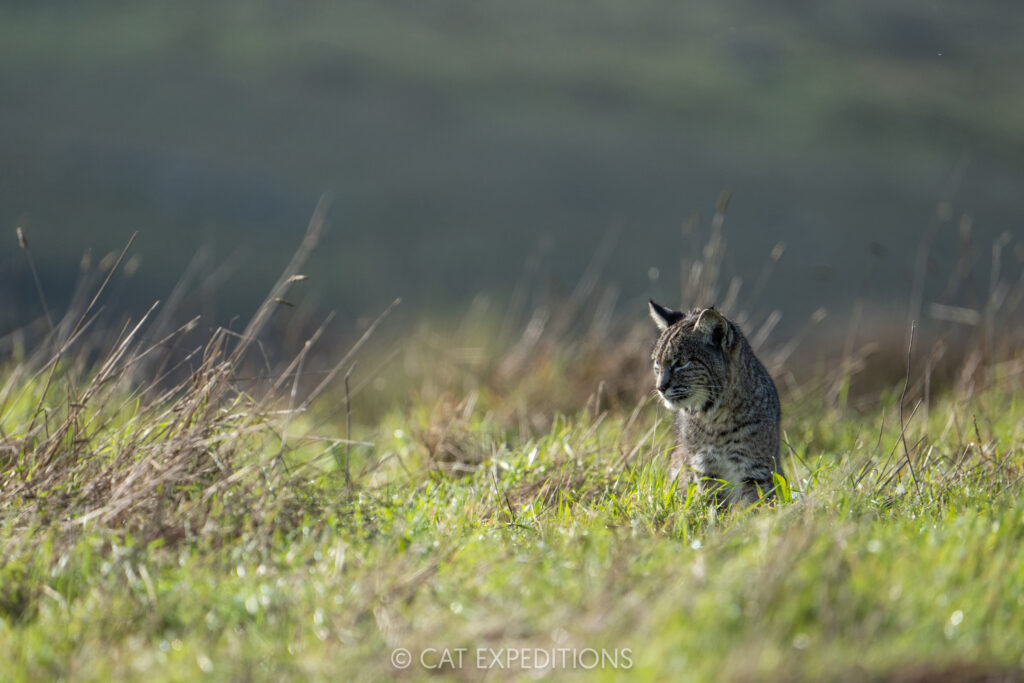
As we were heading toward another area, we spotted a bobcat sitting right beside the road. The cat was positioned patiently at the edge of a gopher hole and clearly waiting for an opportunity. Because he was so close to the road and seemed slightly nervous, we stayed in the vehicles and watched from a distance. After a while, he gave up on the gopher and slowly wandered away up the hillside.
By afternoon, the rain had arrived in earnest.
We encountered several coyotes, and a particularly skittish bobcat that quickly trotted away when we spotted it. Elsewhere, more coyotes were moving through the wet landscape, including the mangy individual we had seen the previous day, whose condition unfortunately looked quite poor.
We continued searching through the wind and rain, checking several different areas before making one final pass through productive bobcat habitat. The Wilson’s Snipes were especially numerous and active close to the road, but despite our efforts, the cats remained hidden.
It was one of those quieter safari days where the weather dictated the pace, but even then, a patient bobcat, active snipes, and plenty of coyotes kept things interesting.
Species List for the Bobcat Photo Tour 2025
Mammals
| Botta’s Pocket Gopher | Thomomys bottae |
| Coyote | Canis latrans |
| Bobcat | Lynx rufus |
| Northern Elephant Seal | Mirounga angustirostris |
| Tule Elk | Cervus elaphus hispanicus |
| Mule Deer | Odocoileus hemionus |
Birds
| Snow Goose | Anser caerulescens |
| Mute Swan | Cygnus olor |
| Mallard | Anas platyrhynchos |
| Greater Scaup | Aythya marila |
| Surf Scoter | Melanitta perspicillata |
| Bufflehead | Bucephala albeola |
| California Quail | Callipepla californica |
| Anna’s Hummingbird | Calypte anna |
| American Coot | Fulica americana |
| Killdeer | Charadrius vociferus |
| Semipalmated Plover | Charadrius semipalmatus |
| Snowy Plover | Charadrius nivosus |
| Whimbrel | Numenius phaeopus |
| Long-billed Curlew | Numenius americanus |
| Marbled Godwit | Limosa fedoa |
| Least Sandpiper | Calidris minutilla |
| Western Sandpiper | Calidris mauri |
| Wilson’s Snipe | Gallinago delicata |
| Ring-billed Gull | Larus delawarensis |
| Pied-billed Grebe | Podilymbus podiceps |
| Common Loon | Gavia immer |
| Double-crested Cormorant | Nannopterum auritum |
| Great Blue Heron | Ardea herodias |
| Great Egret | Ardea alba |
| Snowy Egret | Egretta thula |
| American White Pelican | Pelecanus erythrorhynchos |
| Brown Pelican | Pelecanus occidentalis |
| Turkey Vulture | Cathartes aura |
| Northern Harrier | Circus cyaneus |
| Sharp-shinned Hawk | Accipiter striatus |
| Red-shouldered Hawk | Buteo lineatus |
| Red-tailed Hawk | Buteo jamaicensis |
| Great Horned Owl | Bubo virginianus |
| Burrowing Owl | Athene cunicularia |
| American Kestrel | Falco sparverius |
| Peregrine Falcon | Falco peregrinus |
| Acorn Woodpecker | Melanerpes formicivorus |
| Northern Flicker | Colaptes auratus |
| American Kestrel | Falco sparverius |
| Merlin | Falco columbarius |
| Black Phoebe | Sayornis nigricans |
| Say’s Phoebe | Sayornis saya |
| Steller’s Jay | Cyanocitta stelleri |
| Western Scrub-Jay | Aphelocoma californica |
| American Crow | Corvus brachyrhynchos |
| Common Raven | Corvus corax |
| Chestnut-backed Chickadee | Poecile rufescens |
| Wrentit | Chamaea fasciata |
| Northern House Wren | Troglodytes aedon |
| Marsh Wren | Cistothorus palustris |
| European Starling | Sturnus vulgaris |
| Western Bluebird | Sialia mexicana |
| White-crowned Sparrow | Zonotrichia leucophrys |
| Golden-crowned Sparrow | Zonotrichia atricapilla |
| Song Sparrow | Melospiza melodia |
| Red-winged Blackbird | Agelaius phoeniceus |
| Brewer’s Blackbird | Euphagus cyanocephalus |
| Spotted Towhee | Pipilo maculatus |
| Western Meadowlark | Sturnella neglecta |